Artificial intelligence is transforming how businesses interact with customers, manage operations, and scale growth. One of the most impactful applications of AI is the chatbot.
Modern AI chatbots have evolved far beyond simple scripted responses. Powered by advanced Natural Language Processing (NLP), machine learning, and large language models (LLMs), today’s chatbots can understand context, provide intelligent responses, automate workflows, and deliver personalized experiences across multiple channels.
As customer expectations continue to rise, organizations are increasingly investing in AI chatbot development services to improve efficiency, reduce costs, and enhance customer satisfaction.
This guide explores the top benefits of AI chatbot development services, implementation strategies, costs, ROI, industry use cases, and future trends shaping the conversational AI landscape.
Key Statistics About AI Chatbots
- Businesses can automate a significant percentage of routine customer interactions using AI-powered chatbots.
- Customer support teams increasingly use AI assistants to improve response times and productivity.
- AI-powered customer engagement tools help organizations operate 24/7 without expanding support teams.
- Gartner and other industry analysts continue to identify conversational AI as a major driver of digital transformation initiatives.
- Enterprises across retail, healthcare, banking, logistics, SaaS, and eCommerce are adopting conversational AI solutions to improve operational efficiency.
What Are AI Chatbot Development Services?
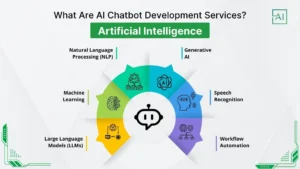
AI chatbot development services involve designing, developing, training, deploying, and maintaining intelligent conversational systems that interact with users through text or voice.
These chatbots leverage technologies such as:
- Artificial Intelligence
- Natural Language Processing (NLP)
- Machine Learning
- Large Language Models (LLMs)
- Generative AI
- Speech Recognition
- Workflow Automation
Quick Answer
AI chatbot development services help businesses create intelligent virtual assistants that automate customer interactions, support operations, generate leads, and improve user experiences while reducing operational costs.
Why AI Chatbots Matter in Modern Business
Customer expectations have changed dramatically.
Users expect:
- Instant responses
- Personalized experiences
- 24/7 availability
- Self-service options
- Consistent communication
Traditional support teams often struggle to meet these demands at scale.
AI chatbots solve this challenge by providing immediate assistance while reducing pressure on human agents.
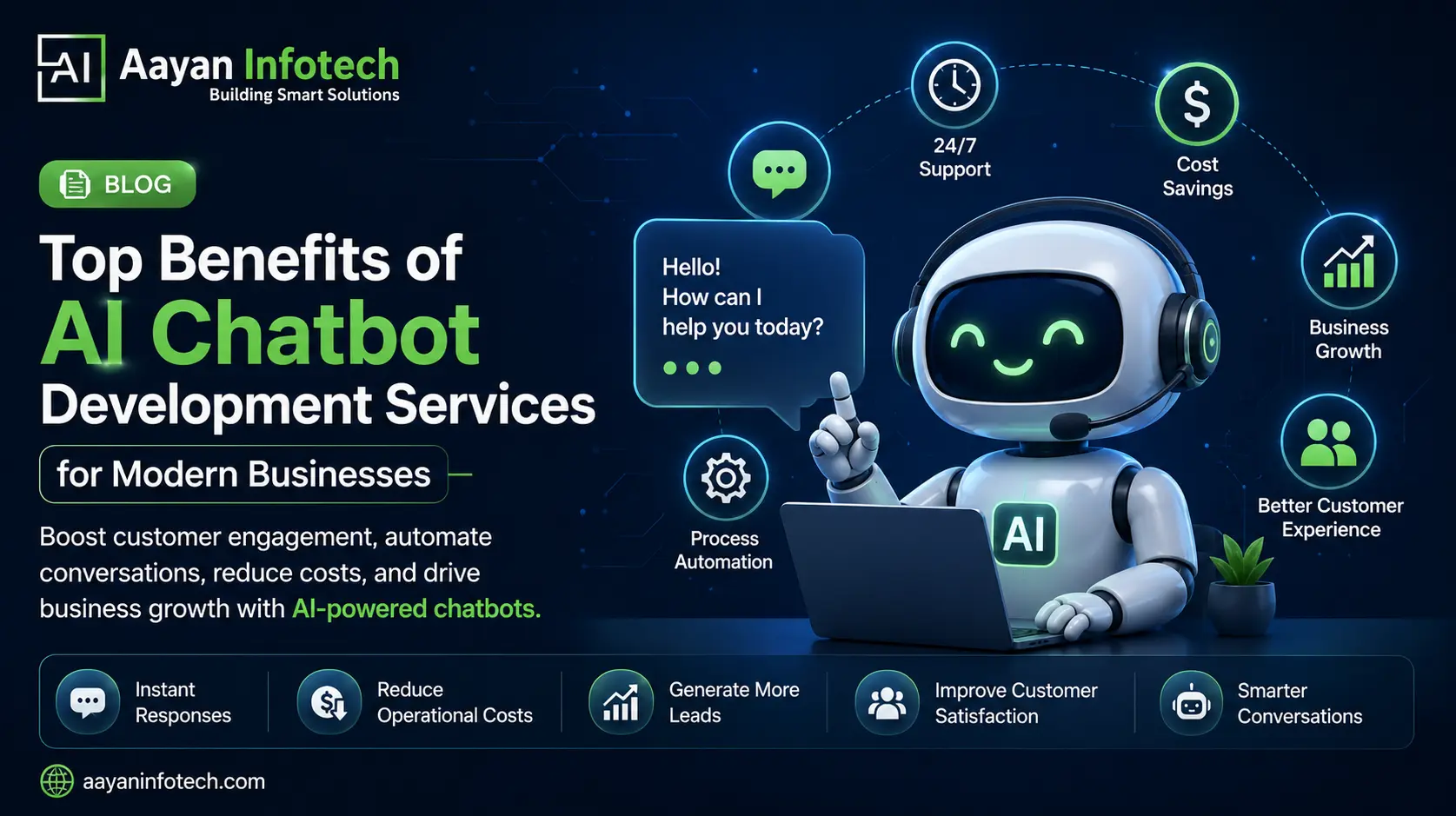
Top Benefits of AI Chatbot Development Services
1. 24/7 Customer Support
One of the biggest advantages of AI chatbots is around-the-clock availability.
Unlike human teams, chatbots can:
- Respond instantly
- Handle inquiries continuously
- Support global customers across time zones
- Reduce waiting times
This improves customer satisfaction while increasing business accessibility.
Business Impact
- Higher customer retention
- Better user experience
- Faster issue resolution
2. Significant Cost Reduction
Customer support operations can be expensive.
AI chatbots help organizations reduce costs by:
- Automating repetitive tasks
- Minimizing support tickets
- Reducing staffing requirements
- Increasing agent productivity
Instead of replacing employees, AI often enables support teams to focus on complex, high-value interactions.
Example
A chatbot handling FAQs, account inquiries, and order tracking can significantly reduce support workload.
3. Faster Response Times
Modern customers expect answers immediately.
AI chatbots can:
- Respond in seconds
- Eliminate hold times
- Process multiple conversations simultaneously
- Deliver consistent information
This creates a more efficient customer experience
4. Improved Lead Generation
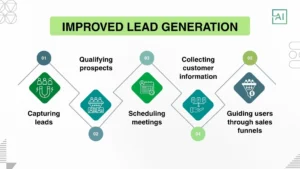
AI chatbots can act as intelligent sales assistants.
Capabilities include:
- Capturing leads
- Qualifying prospects
- Scheduling meetings
- Collecting customer information
- Guiding users through sales funnels
Example
A website chatbot can engage visitors, identify buying intent, and route qualified leads directly to sales teams.
5. Enhanced Customer Experience
Personalization is a key competitive advantage.
AI chatbots can:
- Understand user intent
- Remember conversation history
- Recommend products
- Provide personalized support
- Deliver contextual responses
This creates more engaging customer experiences.
6. Scalability Without Additional Staff
Business growth often increases support demand.
AI chatbots scale effortlessly.
Whether handling:
- 100 conversations
- 1,000 conversations
- 100,000 conversations
The chatbot can continue operating efficiently.
This makes AI particularly valuable for rapidly growing businesses.
7. Increased Employee Productivity
Internal AI chatbots support employees by:
- Answering HR questions
- Assisting IT support
- Providing knowledge base access
- Automating administrative tasks
Employees spend less time searching for information and more time on strategic work.
8. Better Data Collection and Insights
Every conversation generates valuable data.
AI chatbots help organizations understand:
- Customer behavior
- Pain points
- Frequently asked questions
- Buying patterns
- Service gaps
These insights improve decision-making and customer experience strategies.
9. Omnichannel Customer Engagement
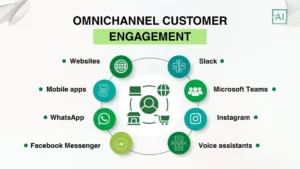
Customers interact through multiple channels.
Modern AI chatbots can integrate with:
- Websites
- Mobile apps
- WhatsApp
- Facebook Messenger
- Slack
- Microsoft Teams
- Instagram
- Voice assistants
This ensures consistent communication across platforms.
10. Competitive Advantage
Organizations that adopt AI early often gain advantages through:
- Faster service
- Lower costs
- Better customer experiences
- Increased efficiency
As AI adoption continues to grow, conversational AI is becoming a critical business capability.
How AI Chatbot Development Works
Step 1: Business Requirement Analysis
Identify:
- Business goals
- Customer needs
- Use cases
- Integration requirements
Step 2: Conversation Design
Develop:
- User flows
- Dialog structures
- Intent mapping
- Response strategies
Step 3: AI Model Selection
Choose appropriate technologies:
- LLMs
- NLP frameworks
- Machine learning models
Step 4: Integration
Connect the chatbot with:
- CRM systems
- ERP platforms
- Helpdesk tools
- Knowledge bases
Step 5: Testing
Validate:
- Accuracy
- Security
- Performance
- User experience
Step 6: Deployment and Optimization
Monitor and continuously improve chatbot performance.
Real Business Use Cases
eCommerce
Chatbots help:
- Product recommendations
- Order tracking
- Returns management
- Customer support
Healthcare
Applications include:
- Appointment scheduling
- Patient support
- Symptom guidance
- Information assistance
Banking and Finance
Common uses:
- Account inquiries
- Transaction support
- Fraud alerts
- Customer onboarding
SaaS Companies
Benefits include:
- User onboarding
- Technical support
- Feature guidance
- Subscription management
Education
Chatbots assist with:
- Student support
- Course recommendations
- Admissions guidance
- Administrative inquiries
AI Chatbot Development Cost
What Influences Cost?
Factors include:
- Complexity
- AI capabilities
- LLM integration
- Custom workflows
- Third-party integrations
- Security requirements
- Training datasets
Typical Cost Ranges
|
Solution Type
|
Estimated Cost
|
| Basic Chatbot |
$5,000 – $15,000 |
| Mid-Level AI Chatbot |
$15,000 – $50,000 |
| Enterprise AI Chatbot |
$50,000 – $250,000+ |
Actual costs vary depending on requirements.
ROI of AI Chatbot Development Services
ROI Drivers
- Reduced support costs
- Increased sales conversions
- Higher customer retention
- Improved operational efficiency
- Better employee productivity
ROI Formula
ROI = (Financial Benefits – Investment Cost) ÷ Investment Cost × 100
Many businesses realize measurable returns within months of deployment
Common Mistakes Businesses Make
- Choosing Rule-Based Bots Only: Traditional bots often fail with complex conversations.
- Ignoring User Experience: Poor conversation design reduces adoption.
- Lack of Integration: Disconnected systems limit chatbot effectiveness.
- No Ongoing Training: AI models require continuous improvement.
- Unrealistic Expectations: AI is powerful but not magic.
Best Practices for AI Chatbot Development
- Define clear objectives
- Focus on customer needs
- Use high-quality training data
- Integrate business systems
- Prioritize security
- Monitor performance
- Continuously optimize
- Combine AI with human escalation
Future Trends in AI Chatbots
- Generative AI Chatbots: Advanced LLMs are enabling more natural conversations.
- Voice-Based AI Assistants: Voice interactions continue to expand.
- Hyper-Personalization: AI will deliver increasingly tailored experiences.
- Autonomous AI Agents: Future systems will perform tasks independently.
- Multimodal AI: Chatbots will understand text, images, documents, and voice simultaneously.
Expert Insights
Organizations increasingly view AI chatbots not merely as customer service tools but as strategic business assets.
The most successful implementations focus on solving real business challenges rather than deploying AI for its own sake.
Businesses that combine conversational AI with enterprise systems, analytics, and workflow automation typically achieve the greatest return on investment.
Ready to build AI-powered chatbot solutions for your business?
Aayan Infotech helps organizations design, develop, and deploy custom AI chatbots, conversational AI platforms, LLM-powered assistants, and enterprise automation solutions tailored to specific business requirements.
Whether you need customer support automation, lead generation chatbots, employee assistants, or enterprise-grade conversational AI systems, our experts can help.
Contact Aayan Infotech today to discuss your AI chatbot development project and accelerate your digital transformation journey.