A successful online store needs more than a website. A mobile shopping app can give customers a faster and more convenient way to browse products, compare options, place orders, and receive updates. Aayan Infotech provides ecommerce app development company solutions designed around your products, customers, business model, and growth goals.
Our ecommerce app development services cover the complete development journey, from planning and UI/UX design to development, integrations, testing, deployment, and ongoing improvements. Whether you are launching a new online store or expanding an existing ecommerce business, our team can help create a scalable mobile shopping experience for customers worldwide.
Building an ecommerce application involves more than creating attractive screens. The app needs to connect different business functions, including product catalogues, customer accounts, shopping carts, payment processing, inventory, order management, notifications, and analytics.
Working with an experienced ecommerce app development company gives your business access to developers and technical specialists who can plan these components together. This can help reduce development gaps, improve usability, and create a more consistent customer journey.
A professionally developed ecommerce app can also provide a direct digital channel between your business and customers. Instead of depending only on browser-based shopping, you can offer customers a dedicated experience designed specifically for mobile devices.
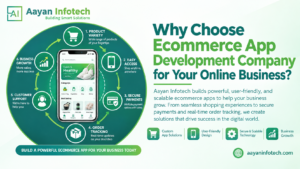
An ecommerce mobile app can support customers throughout their shopping journey.
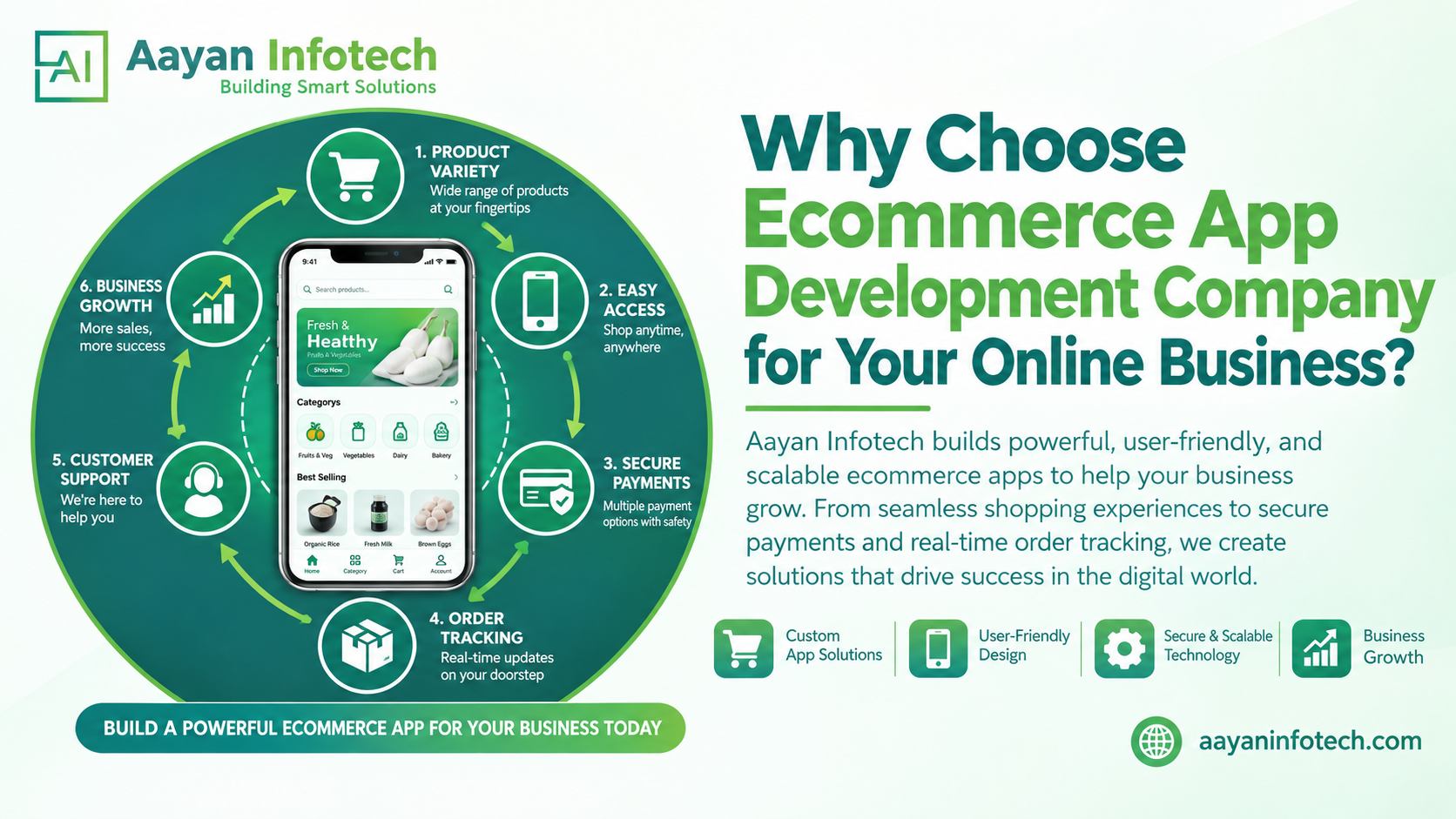
Customers can browse categories, search for products, apply filters, view product details, and check availability from their mobile devices. A well-structured product catalogue makes it easier for users to find relevant products without unnecessary navigation.
A smooth checkout experience is important for ecommerce businesses. Your application can include shopping cart management, address selection, shipping options, order summaries, discount codes, and secure payment integration.
Users can create accounts, manage personal information, save addresses, view previous orders, track purchases, and manage preferences from one place.
Order tracking can keep customers informed after purchase. Depending on your business requirements, the app can display order status, shipping information, delivery updates, and notifications.
Push notifications can be used for relevant customer communication, such as order updates, delivery information, product availability, promotions, or abandoned-cart reminders.
Aayan Infotech can help businesses build ecommerce applications around their specific requirements instead of relying on a one-size-fits-all solution.
Custom ecommerce app development allows your application to be designed around your business model, target customers, product catalogue, workflows, and operational requirements.
The development approach can include custom user interfaces, product management, customer accounts, checkout workflows, payment integration, order processing, notifications, and third-party APIs.
Mobile commerce requires interfaces that work naturally on smaller screens and different devices. Our ecommerce mobile app development approach focuses on responsive layouts, intuitive navigation, fast interactions, accessible product information, and a simple purchasing journey.
Apps can be developed for platforms such as Android and iOS, depending on the business requirements and selected technology approach.
An ecommerce application development company can support more than the coding stage. Proper planning involves understanding business requirements, defining features, selecting the appropriate technology, designing the user experience, integrating backend systems, testing the application, and preparing it for deployment. This complete approach can help businesses create an ecommerce application that is easier to maintain and expand.
Experienced ecommerce app developers work with different components of an online shopping ecosystem. This may include frontend interfaces, backend services, databases, APIs, payment systems, authentication, cloud infrastructure, analytics, and third-party integrations. The right development team can also help identify technical requirements before development begins, reducing the possibility of major changes later in the project.
The exact features should depend on your business model and customer requirements. Common ecommerce application features include:
| Feature | Purpose |
| Product Catalogue | Helps customers browse products and categories |
| Product Search & Filters | Makes it easier to find relevant products |
| Shopping Cart | Allows users to review and manage selected products |
| Secure Checkout | Supports a smoother purchasing process |
| Payment Integration | Enables secure online transactions |
| Order Tracking | Keeps customers informed about order status |
| Push Notifications | Provides order, delivery, and product updates |
| Wishlist | Lets customers save products for later |
| Customer Reviews | Helps users evaluate products |
| Inventory Integration | Connects product availability with business systems |
| Admin Dashboard | Helps manage products, orders, customers, and analytics |
A dedicated shopping application can provide a focused experience without the distractions that may exist on a traditional website. Customers can access products, accounts, orders, and other shopping functions from one application.
Custom development allows the application to follow your business processes. Features can be added or modified based on your products, target market, logistics, payment methods, and customer requirements.
An ecommerce app may need to communicate with existing business systems. API integration can connect the application with inventory management, CRM platforms, ERP systems, payment gateways, shipping providers, analytics tools, and other services.
A growing ecommerce business may experience increases in products, customers, orders, and transactions. A scalable architecture can make it easier to add features and support increasing usage over time.
A mobile application creates another channel for communicating with customers. Relevant notifications and personalized experiences can help businesses maintain ongoing customer interaction.
A structured development process helps transform an ecommerce idea into a functional application.
We start by understanding your business model, target audience, products, competitors, operational requirements, and application goals. This stage helps establish the scope and functionality of the project.
The required features are organized according to business priorities. The development roadmap can separate essential launch features from future enhancements.
The design process focuses on navigation, product discovery, usability, checkout flow, accessibility, and consistent visual presentation.
Developers build the frontend, backend, database structure, APIs, authentication, business logic, and required integrations according to the approved specifications.
Payment gateways, shipping services, inventory systems, analytics platforms, CRM tools, and other required services can be integrated into the application.
The application is tested for functionality, usability, performance, compatibility, security, and common user journeys before release.
After testing and approval, the application can be prepared for deployment to the relevant app stores and production infrastructure.
After launch, the application can be monitored and improved based on user feedback, business requirements, performance data, and new feature requirements.
The cost of ecommerce app development depends on the scope and technical requirements of the project. A basic shopping application will generally require a different development effort than a large marketplace with multiple sellers, complex inventory management, advanced analytics, international payments, and third-party integrations.
| Cost Factor | How It Can Affect Development |
| Number of Platforms | Android, iOS, or both can change development requirements |
| App Features | More features generally require more development work |
| UI/UX Complexity | Custom and advanced interfaces can increase design effort |
| Integrations | Payment, shipping, CRM, ERP, and API integrations add technical requirements |
| Backend Architecture | Complex business logic and data requirements can increase development scope |
| Security Requirements | Authentication, payment security, and data protection require additional work |
| Admin Dashboard | Advanced management and analytics features can expand the project scope |
| Multi-Language & Currency | International ecommerce requirements may need additional functionality |
| Maintenance | Ongoing updates, monitoring, bug fixes, and improvements require continued resources |
Instead of using a fixed price for every project, businesses should define the required functionality and technical scope first. Aayan Infotech can then discuss the project requirements and development approach with you.
An ecommerce application can be useful for different types of online businesses, including:
The application structure can be adapted according to the products, customers, business model, and operational workflow.
Aayan Infotech works with businesses that need custom digital products and mobile applications. Its current service portfolio includes mobile app development, custom software development, developer hiring, and solutions for retail and ecommerce businesses. The company works with startups, enterprises, and global brands and supports technology requirements across different industries. Its development capabilities include mobile technologies and a broader software engineering ecosystem.
For an ecommerce project, the development team can work across planning, UI/UX, mobile development, backend development, integrations, testing, deployment, and future enhancements. The objective is to create an ecommerce application that supports both customer needs and business operations rather than simply delivering a basic shopping interface.
Ecommerce businesses increasingly serve customers across multiple markets, which can create additional application requirements. Depending on the target market, an ecommerce app may need multiple languages, currencies, payment methods, shipping integrations, tax considerations, and region-specific customer experiences.
Aayan Infotech provides software and mobile app development services for businesses across international markets. A project can therefore be planned around the locations, customer groups, operational systems, and future expansion goals relevant to your business.
A custom ecommerce app may be worth considering when your existing website cannot provide the customer experience or business functionality you need.
Common situations include:
Before development begins, it is useful to define the business problem the app needs to solve. This helps prevent unnecessary features and keeps development aligned with measurable business requirements.
Your ecommerce application should make shopping easier for customers while supporting the operational needs of your business. From product browsing and checkout to payment processing, order management, notifications, analytics, and third-party integrations, every component should work together as part of a reliable digital shopping experience.
Aayan Infotech is an Ecommerce App Development Company that can help turn your ecommerce idea into a custom mobile application designed around your business requirements and future growth.
Have an ecommerce app idea? Talk to Aayan Infotech about your requirements and plan your next digital product.