MLM software is a technology platform designed to help multi-level marketing and direct-selling businesses manage distributors, sales networks, commissions, orders, payouts, memberships, and performance from a centralized system.
As an MLM business grows, managing thousands of distributors and multiple levels of a sales network through spreadsheets or disconnected tools becomes difficult. MLM software helps automate these processes while giving administrators and distributors access to real-time information.
This guide explains what MLM software is, how MLM software works, its key features, major benefits, compensation plans, security considerations, and how businesses can choose the right MLM software solution.
MLM software is a web-based or cloud-based system used to manage the operational and financial activities of a multi-level marketing business. An MLM business typically has a network structure where distributors or participants can sell products or services and may introduce new participants. The resulting structure is commonly organized into levels, teams, or downlines.
Instead of manually calculating commissions, tracking distributor activity, managing orders, or maintaining network records, an MLM software platform can automate these workflows.
A typical system may include:
The exact features depend on the business model, compensation structure, products, countries served, payment methods, and compliance requirements.
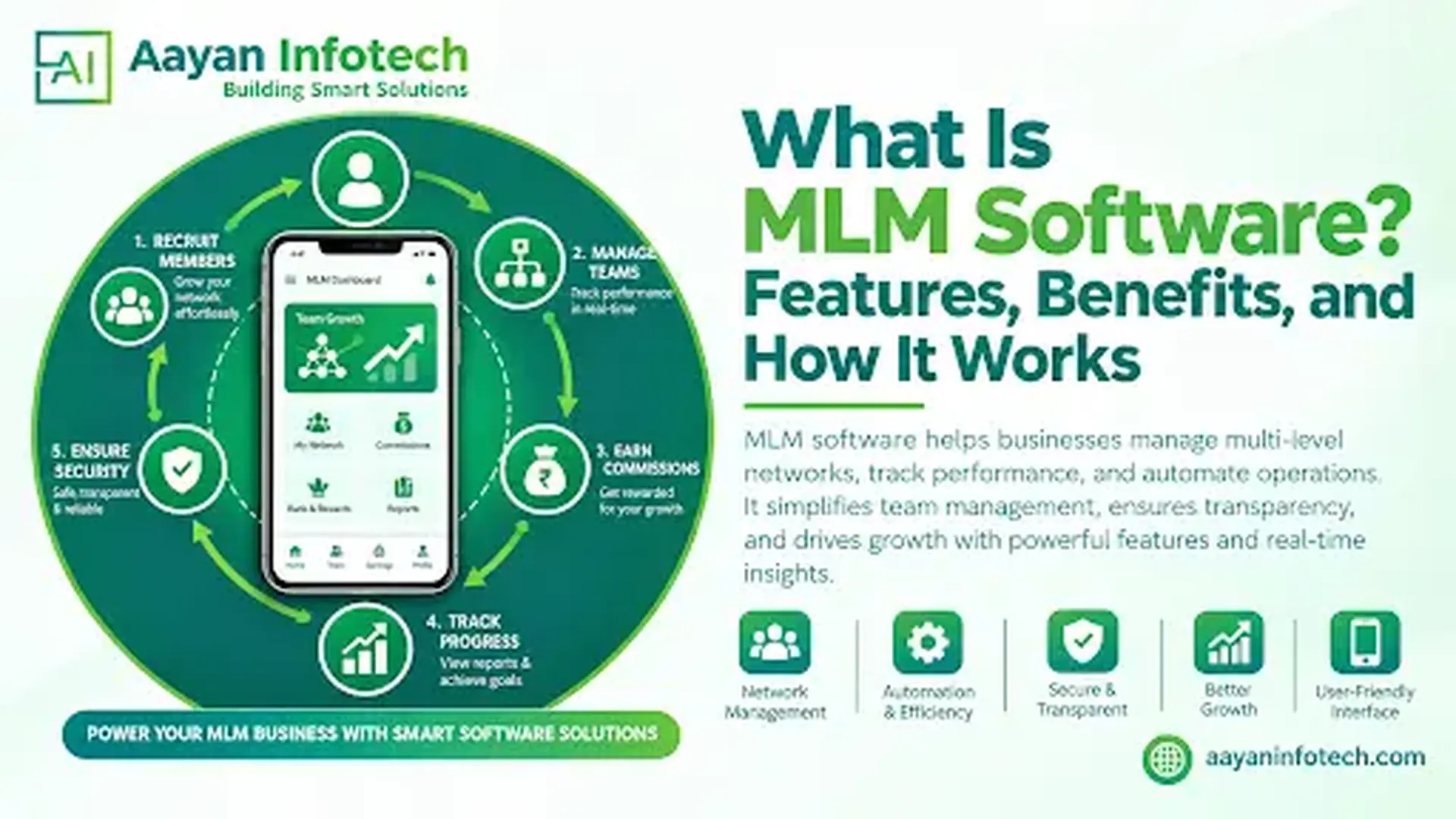
MLM software works by connecting the different operational parts of an MLM business through a centralized platform.
The basic workflow can be explained in a few steps.
A new distributor creates an account through the MLM website or application. The system stores their profile, identification information, sponsor details, and account status. Depending on the business model and applicable laws, registration may also include verification or approval workflows.
The system connects the new distributor with their sponsor and places them within the appropriate network structure. The software can maintain relationships between sponsors, recruits, teams, and downlines.
Distributors or customers can purchase products or services through the platform. The system records orders, payment status, customer details, and sales activity.
MLM management software tracks eligible sales and other activities defined by the business’s compensation plan. This information can then be used to calculate commissions, bonuses, ranks, or other incentives.
The system applies the configured compensation rules to eligible transactions. Instead of manually calculating payouts, the software can automatically determine applicable commissions according to the business rules.
Eligible earnings may appear in a distributor wallet or earnings dashboard. Depending on the implementation, the system may support withdrawal requests, payout approvals, payment integrations, transaction histories, and financial reports.
Administrators can monitor sales, distributor activity, team performance, orders, commissions, ranks, and other business metrics through reports and dashboards. This creates a single source of operational information for the organization.
A modern MLM software solution should support the core workflows of both administrators and distributors.
Distributor management provides administrators with a centralized view of users and their account information.
Common capabilities include:
This reduces manual administration as the network grows.
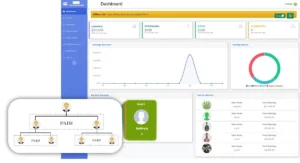
The genealogy system is one of the most important components of multi-level marketing software. It displays relationships between sponsors, distributors, teams, and downline members. Depending on the compensation structure, the platform may support different network arrangements and provide both visual and tabular views.
A well-designed network interface should make it easy for users to understand:
The compensation plan determines how eligible commissions and bonuses are calculated.
An MLM software platform may be configured to support models such as:
However, the software should not determine whether a particular compensation plan is legally compliant. Businesses need to review their model against applicable laws and regulations in each market. The Federal Trade Commission notes that the legality of an MLM structure depends on how the business operates in practice and what its compensation structure incentivizes.
Automated commission calculation can reduce errors and administrative workload. The system can calculate eligible commissions based on configured business rules and transaction data.
Possible earning categories may include:
The exact rules should be clearly defined before development.
For product-based MLM businesses, the platform can manage products, pricing, inventory information, orders, customers, and sales transactions. This can connect the sales process with distributor accounts and commission calculations.
An integrated wallet can give distributors a clear view of their eligible balance and transaction history.
Common functions include:
Financial workflows should be designed with appropriate security, auditability, and local regulatory requirements in mind.
Businesses can define rank criteria based on their compensation model. The system can track qualifying activities and display current rank, progress, team performance, and applicable incentives. This gives distributors a clearer view of their performance without requiring manual calculations.
The administrator dashboard acts as the control center for the MLM business.
It may provide access to:
Role-based access controls can help limit sensitive functions to authorized users.
A distributor dashboard provides personalized information in one place.
Depending on the business model, distributors may see:
A simple dashboard can improve usability, especially for large networks.
Reporting helps administrators understand business performance.
Useful reports can include:
Advanced implementations can also include dashboards and business intelligence tools.
MLM management software can provide automated notifications for important events.
Examples include:
Email, SMS, push notifications, or in-app notifications can be used depending on the application.
Distributors often need access to their accounts while working remotely.
Responsive web interfaces and dedicated mobile applications can allow users to check sales, network activity, earnings, notifications, and other information from smartphones.
For businesses requiring a dedicated mobile experience, MLM application development can be considered alongside the web platform.
One important part of MLM software development is translating the business’s compensation model into clear technical rules.
A unilevel structure generally places personally sponsored distributors on the same first level, with subsequent recruits forming deeper levels. The software needs to track the hierarchy and apply the configured rules to eligible activity.
A binary model generally uses two primary legs or branches. The system needs to maintain the binary tree and calculate applicable rewards according to the business’s specific rules.
A matrix model typically uses predefined width and depth. The software must manage placement, network relationships, qualification rules, and applicable rewards.
A hybrid model combines elements from more than one compensation structure. This can require more detailed business-rule configuration and testing during development.
Important: A software platform can automate a compensation plan, but automation does not make the plan legally compliant. Businesses should obtain appropriate legal and regulatory advice before launching an MLM program.
Manual calculations and spreadsheets become increasingly difficult as a network grows. Automation can reduce repetitive administrative work across distributor management, sales tracking, commission processing, and reporting.
Commission calculations can involve multiple conditions and levels. Centralized rules and automated processing can help reduce manual calculation errors and create a consistent process.
Distributors can view relevant information through their dashboards. Access to transaction histories, network information, sales activity, and commission records can make the system easier to understand.
A scalable MLM software platform can support increasing numbers of users, transactions, products, and business operations. Scalability should be considered during architecture planning rather than added only after performance problems appear.
Automation can reduce the amount of manual work required for distributor onboarding, reporting, order processing, commission calculations, and payout workflows.
Centralized analytics can help management understand sales activity, network growth, product performance, and other operational metrics.
A simple interface gives distributors easier access to the information they need. This can include personal sales, team activity, rank information, commissions, wallet transactions, and notifications.
Managing an MLM business manually may work for a small operation, but complexity increases quickly.
| Area | Manual Management | MLM Software |
| Distributor records | Spreadsheets or separate tools | Centralized database |
| Network tracking | Manual updates | Automated structure |
| Commission calculation | Time-consuming | Rule-based automation |
| Reports | Manual preparation | Real-time dashboards |
| Payout tracking | Multiple records | Centralized workflow |
| Distributor access | Limited | Self-service dashboard |
| Scalability | Difficult | Designed for growth |
| Data visibility | Fragmented | Centralized |
The right approach depends on the size and complexity of the business, but software becomes increasingly valuable as transaction volume and network size grow.
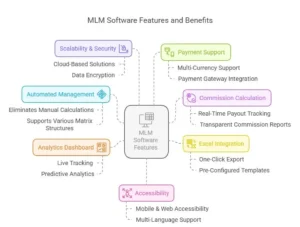
Choosing an existing platform is not always enough. Some businesses have unique compensation rules, product structures, integrations, regional requirements, or distributor workflows. In those cases, MLM software development may be more suitable.
Before development begins, define:
Document how distributors, customers, products, sales, referrals, commissions, and payouts will work.
Every commission and bonus should have a clearly defined rule. Avoid starting development with vague requirements such as “calculate commissions automatically.” Developers need precise business logic.
Define who can access and manage:
Potential integrations may include:
The required integrations depend on the business and target markets.
MLM platforms can handle personal information, financial records, sales data, and account credentials.
Security planning should therefore include:
The architecture should be able to handle increasing users and transactions without creating bottlenecks. Cloud infrastructure, database design, caching, API architecture, and performance testing should be considered during development.
Choosing an MLM software development company should involve more than comparing prices. Evaluate the provider based on:
The development team should understand how to translate compensation rules and network relationships into reliable software.
Your platform should be adaptable to your business model rather than forcing your operations into an unsuitable structure.
Ask how the development company approaches authentication, authorization, data protection, testing, backups, and monitoring.
Check whether the team can integrate required payment, CRM, accounting, communication, and third-party services.
Ask how the proposed architecture will handle future growth.
Understand how the company manages:
A structured development process can reduce technical and operational risks.
An MLM business may need both a website and a mobile experience.
MLM website development generally focuses on the public website, distributor portal, customer experience, product information, registration, and web-based account management.MLM application development focuses on mobile experiences for distributors, customers, or administrators. A mobile application can be useful when distributors frequently need access to network information, sales activity, notifications, or account data while away from a desktop. The right approach depends on user behavior, business requirements, budget, and target markets.
There is no single price for MLM software.
The cost depends on factors such as:
A basic platform with standard functionality can have very different requirements from a large enterprise-grade MLM software solution with custom business logic and multiple integrations.
The best approach is to define the functional requirements first and then obtain a project estimate based on the actual scope.
No.
A business should first establish a legitimate product or service, clear commercial processes, appropriate compensation rules, and applicable legal requirements.
Software should support those operations rather than be used to create an artificial recruitment-driven model. The FTC states that having real products or retail customers does not automatically determine whether an MLM structure is lawful. Its assessment can depend on the compensation structure and how the business operates in practice.
Businesses should also be careful with earnings claims. FTC guidance says earnings representations should be truthful, substantiated, and representative of what typical participants are likely to achieve after considering relevant expenses. Because MLM laws and direct-selling regulations can vary by country, businesses should seek qualified legal advice for each market in which they operate.
Aayan Infotech provides custom software development services for businesses that need solutions aligned with their specific workflows. Its development process covers requirements analysis, planning, design, development, testing, deployment, and ongoing support. The company also provides API development and software integration services for businesses that need their software connected with other systems.
For an MLM project, a custom development approach can help businesses define the distributor experience, network structure, compensation logic, dashboards, integrations, reporting, and scalability requirements before development begins.
The development process can be structured around:
The objective should be to build an MLM software solution that is secure, scalable, maintainable, and aligned with the actual business model.
Planning to build a secure and scalable MLM software platform for your business? Aayan Infotech can help you plan a customized solution based on your business model, distributor network, compensation structure, dashboards, integrations, and growth requirements.
Whether you need MLM software development, MLM website development, MLM application development, or a complete MLM software solution, the right technology can help streamline network management, sales tracking, commission processing, reporting, and distributor operations.
Have an MLM software project in mind? Share your requirements with the Aayan Infotech team at info@aayaninfotech.com You can discuss your business model, required features, integrations, and development goals to determine the right approach for your project.pending on the project’s requirements.