
Middle Eastern organizations in the healthcare sector are hastening digital transformation to achieve increased patient expectations, regulatory demands and efficiency needs in operations. Healthcare software is no longer an option but a necessity, both in terms of hospital information systems and AI-driven diagnostics sites.
Nonetheless, the question that is most frequently put forward by decision-makers is: How much is the cost of healthcare software development in the Middle East in 2026?
This is a practical, practical breakdown of expenses, market forces, and cost of hidden costs and optimization techniques to enable organizations make wise investment decisions.
Healthcare ecosystem in the Middle East is changing at a very high rate due to population growth, medical tourism, and national digital health-related policies (Saudi vision 2030, UAE Digital health strategy and Qatar National health strategy).
Healthcare software in the region typically includes:
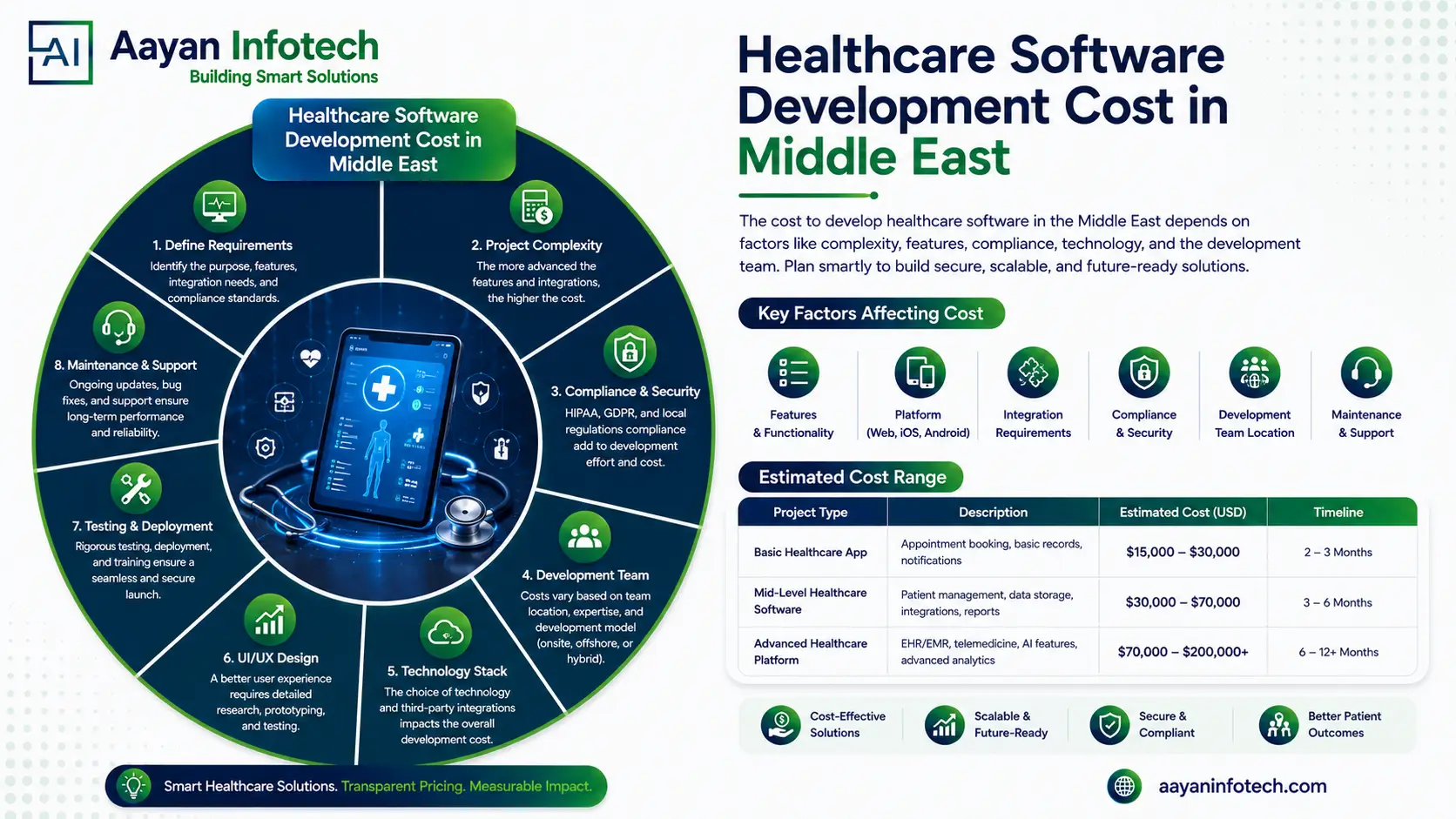
Due to strict data protection laws and region-specific compliance requirements, the cost to develop a healthcare software in the Middle East is often higher than generic enterprise software.
The healthcare software development cost depends on multiple layers—planning, design, development, security, compliance, and long-term maintenance.
| Software Type | Estimated Cost (USD) |
| Development Stage | Cost Range (in USD) |
| UI/UX Design | $1,000 – $3,000 |
| Frontend Development | Depends upon business days |
| Backend Development | Depends upon business days |
| QA & Testing | Depends upon business days |
| Third-Party Integrations | Depends on the API |
| Maintenance & Updates | $350 for month & 15& of total project amount for year |
Costs vary depending on country, regulatory requirements, and customization depth.
Includes business analysis, compliance mapping, technical feasibility, and risk assessment.
Healthcare platforms require intuitive, role-based interfaces for clinicians, patients, and administrators.
Backend logic, frontend development, APIs, integrations, and database architecture form the largest cost component.
Includes functional testing, security audits, compliance validation, and performance testing.
Cloud setup, DevOps pipelines, and production rollout.
| Software Type | Development Timeline |
| Simple | 3 to 6 months |
| Medium Complex | 9 to 10 months |
| Highly Complex | 12 + months |
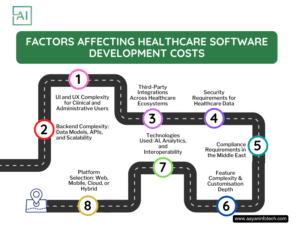
The amount of development work is quantified in person-months, which includes developers, designers, QA engineers, Devops and compliance experts.
Medical personnel, nurses, patients, insurance companies and administrators need different workflows adding more design and development.
Healthcare platforms are exposed to huge quantities of data, real-time data, and high availability needs, which influence infrastructure and engineering expenses.
This is complicated and expensive to integrate with labs, pharmacies, insurance companies, payment gateways and national health data bases.
It is required to be advanced on encryption and access controls, audit logs, and breach preventive.
Healthcare software must comply with:
Compliance implementation alone can account for 15–25% of the total healthcare software development cost in the Middle East.
Advanced healthcare software increasingly uses:
These technologies increase development cost but deliver long-term ROI.
Enterprises address these challenges through modular architecture and compliance-first development strategies.
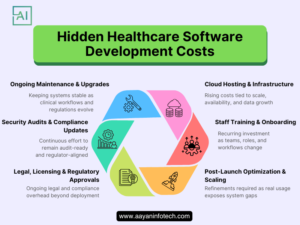
Annual maintenance typically costs 15–20% of initial development.
Scalable hosting, backups, and disaster recovery add recurring costs.
Mandatory audits and evolving regulations increase long-term expenses.
Healthcare staff require extensive system training.
Often underestimated but critical in the Middle East.
Performance tuning and feature enhancements after launch.
Avoid unnecessary features during initial launch.
Focus on regulatory essentials before enhancements.
Allows future scalability without full redevelopment.
Reduces cost across web and mobile platforms.
Combines cost efficiency with regional expertise.
| Region | Hourly Rates of Development |
| UAE | $25 |
| USA | $25 |
| Western Europe | $25 |
| Australia | $25 |
| Eastern Europe | $25 |
| Asia | $25 |
Partnering with an experienced provider ensures:
Aayan Infotech delivers custom healthcare software solutions aligned with Middle East regulations, enterprise scalability, and modern patient engagement needs.
Aayan Infotech is characterized by a highly qualified staff, individual solutions, and clear process of development. Using the modern technologies, scalable backend services, and easy to use designs, we provide end to end services, ideation to maintenance. We have experience in the cross-platform, cross-industry, and all the mobile applications we create are not only business-oriented but also future-oriented and useful. Contact us today at +91 7007120194 or email us at info@aayaninfotech.com.
Costs range depending on complexity and compliance. Contact us today at +91 7007120194 or email us at info@aayaninfotech.com.
Security, compliance, integrations, and data sensitivity increase development effort.
Anywhere from 3 months for MVPs to 12+ months for enterprise systems. Contact us today at +91 7007120194 or email us at info@aayaninfotech.com.
Yes, compliance can add 15–25% to total development cost.
Yes, for scalability and long-term efficiency, despite recurring costs. Contact us today at +91 7007120194 or email us at info@aayaninfotech.com.
Yes, through MVP development, modular design, and strategic outsourcing.
Aayan Infotech combines regional compliance expertise, scalable architecture, and cost-optimized development for Middle East healthcare enterprises. Contact us today at +91 7007120194 or email us at info@aayaninfotech.com.