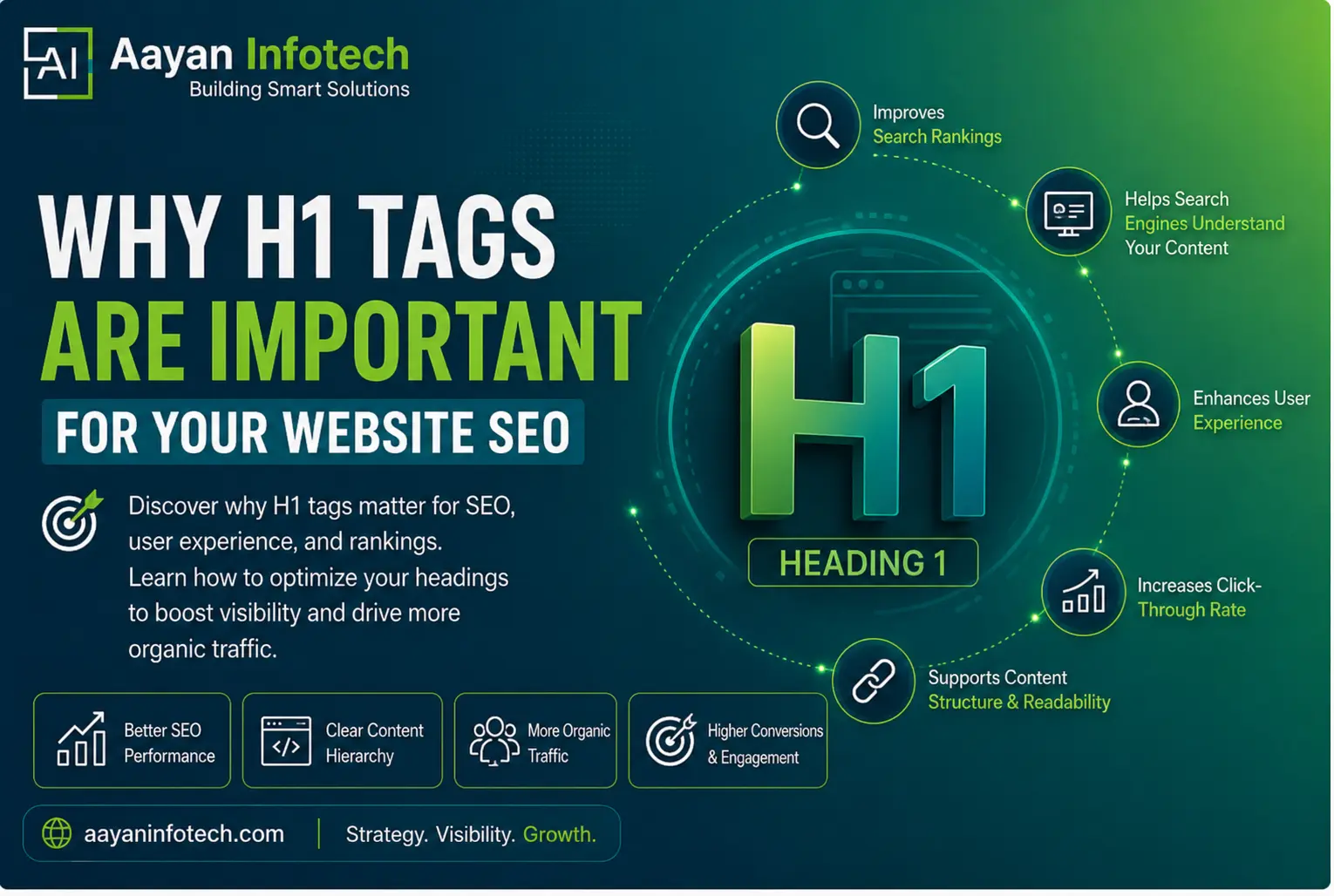
If you’re wondering why H1 tags are important for your website SEO, you’re not alone. Many business owners and marketing professionals focus on keywords, backlinks, and content while overlooking one of the simplest on-page SEO elements: the H1 tag.
An H1 tag acts as the main heading of a webpage. It tells both visitors and search engines what the page is about. When written correctly, an H1 helps search engines understand your content, improves readability, and creates a better user experience. Although Google has stated that H1 tags are not the single most important ranking factor, they remain a valuable part of a strong SEO strategy because they provide context and structure.
Whether your business operates in India, or serves clients across the USA, UK, Australia, and Canada, using optimized H1 tags can help improve your website’s visibility and support your overall digital marketing efforts.
In this guide, you’ll learn why H1 tags are important for your website SEO, how to optimize them correctly, common mistakes to avoid, and practical examples you can apply to every page of your website.
An H1 tag is the primary heading on a webpage. It is created using the HTML <h1> element and usually appears at the top of the page. Think of it as the title visitors read after landing on your website.
For example:
H1
Why H1 Tags Are Important for Your Website SEO
Supporting headings are then organized with H2, H3, and H4 tags, creating a logical content hierarchy.
A properly structured page might look like this:
This hierarchy makes it easier for users to scan content and helps search engines understand the relationship between different sections.
The reason why H1 tags are important for your website SEO is simple: they provide context.
When Google’s crawlers visit a webpage, they analyze headings, page titles, content, images, links, and other elements to determine what the page discusses. A clear H1 reinforces the main topic and supports your target keywords naturally.
An optimized H1 tag offers several benefits:
A descriptive H1 immediately tells search engines what the page covers. This helps align the page with relevant search queries and improves topical relevance.
Users rarely read every word on a page. Instead, they scan headings before deciding whether to continue reading. A well-written H1 encourages visitors to stay engaged.
H1 tags work alongside title tags, meta descriptions, URLs, image alt text, and internal links. Together, these elements create a strong on-page SEO foundation.
Screen readers often use heading tags to help visually impaired users navigate webpages. Proper heading structure makes your content easier to access and improves usability.
A compelling H1 captures attention within seconds. When visitors immediately understand the page’s purpose, they are more likely to continue reading, reducing bounce rates and increasing time on page.
Search engines evaluate multiple signals to understand a webpage. While Google’s algorithms are sophisticated enough to interpret content without relying solely on headings, H1 tags still provide valuable context.
A strong H1 helps search engines:
Modern SEO is about combining many optimization techniques rather than depending on a single ranking factor. An optimized H1 complements high-quality content, fast page speed, mobile responsiveness, internal linking, and user experience.
For businesses investing in long-term SEO, every optimization contributes to stronger overall performance.
Many people assume that the H1 tag and the title tag are the same. While they often contain similar wording, they serve different purposes in SEO.
| H1 Tag | Title Tag |
| Appears on the webpage | Appears in Google search results and browser tabs |
| Helps users understand the page | Encourages users to click your page |
| Supports content structure | Supports search visibility and click-through rate |
| Used once on the page | Unique for every page |
For example:
Title Tag:
Why H1 Tags Are Important for Your Website SEO | Aayan Infotech
H1 Tag:
Why H1 Tags Are Important for Your Website SEO
Your title tag can be slightly more descriptive or include your brand name, while your H1 should clearly describe the main topic of the page.
One of the biggest reasons why H1 tags are important for your website SEO is that they create a logical content hierarchy.
Think of your webpage as a well-organized book:
This hierarchy helps both users and search engines understand your content more efficiently.
For long-form content, proper heading structure improves readability by breaking information into manageable sections. Visitors can quickly find the information they need instead of scrolling through large blocks of text.
Keeping your H1 under 60 characters is a good SEO and usability practice. Short, descriptive headings are easier for visitors to read and quickly communicate the page’s main topic. While search engines do not enforce a strict character limit for H1 tags, concise headings improve readability, especially on mobile devices, and help users understand your content at a glance. Focus on including your primary keyword naturally without adding unnecessary words.
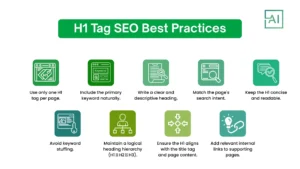
Following proven SEO best practices ensures your H1 tag supports both rankings and user experience.
Every page should have a single, descriptive H1 that represents the primary topic. While modern search engines can understand pages with multiple H1 tags, using one main heading remains the clearest and most consistent approach.
Your focus keyphrase should appear naturally within the H1. Avoid forcing keywords or making the heading sound unnatural.
Good Example:
Why H1 Tags Are Important for Your Website SEO
Poor Example:
H1 Tags SEO Website SEO H1 SEO Guide H1 Tags
The first example is readable and user-friendly, while the second is an example of keyword stuffing.
A strong H1 immediately tells readers what they will learn.
Instead of writing:
SEO Guide
Use:
Why H1 Tags Are Important for Your Website SEO
Specific headings improve user engagement and provide better context for search engines.
Before writing an H1, ask yourself:
A heading aligned with search intent is more likely to attract the right audience and improve engagement.
Although there is no strict character limit, aim for approximately 20–70 characters. A concise heading is easier to read and more impactful.
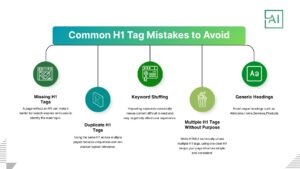
Even well-designed websites sometimes overlook H1 optimization. Avoid these common mistakes to maximize your SEO potential.
A page without an H1 can make it harder for search engines and users to identify the main topic.
Using the same H1 across multiple pages reduces uniqueness and can weaken topical relevance.
Repeating keywords unnaturally makes content difficult to read and may negatively affect user experience.
Instead of:
SEO Services SEO Company SEO Agency SEO Experts
Use:
Professional SEO Services for Business Growth
While HTML5 technically allows multiple H1 tags, using one clear H1 keeps your page structure simple and consistent.
Avoid vague headings such as:
Instead, make your H1 descriptive and keyword-focused, such as:
Professional Website Development Services
or
Custom SEO Services for Growing Businesses
SEO is no longer just about search engines. User experience plays a significant role in determining how visitors interact with your website.
A well-crafted H1 contributes to a positive experience by:
When users find exactly what they expect after clicking a search result, they are more likely to stay on the page, explore additional content, and take action.
For businesses targeting specific geographic locations, H1 tags can strengthen local relevance.
If your company serves customers in India, or international markets like the USA, UK, and Australia, including location-based keywords naturally within your headings can help improve visibility for local searches.
Examples include:
When combined with optimized Google Business Profile listings, location-specific landing pages, consistent NAP (Name, Address, Phone Number) details, and LocalBusiness schema markup, these H1 tags contribute to a stronger local SEO strategy.
Here are a few examples of SEO-friendly H1 tags for different industries:
Web Development
Custom Website Development Services for Growing Businesses
Digital Marketing
Complete Digital Marketing Solutions to Grow Your Brand Online
SEO
Professional SEO Services That Increase Organic Traffic
Software Development
Custom Software Development for Modern Businesses
eCommerce
eCommerce Website Development Services for Online Stores
Each example is clear, descriptive, user-focused, and naturally incorporates the page’s primary topic without overusing keywords.
By consistently applying these practices across your website, you create a stronger foundation for both search engine optimization and a better user experience.
Before publishing a page, review this checklist:
Following these best practices can improve your website’s structure, accessibility, and overall SEO performance.
Understanding Why H1 tags are important for your website SEO is essential for building a well-optimized website. Although H1 tags alone won’t guarantee higher rankings, they play a vital role in helping search engines understand your content, improving page structure, enhancing accessibility, and delivering a better user experience.
When combined with high-quality content, technical SEO, fast-loading pages, internal linking, optimized images, and a mobile-friendly design, a well-crafted H1 becomes a valuable part of a successful SEO strategy.
Whether you’re managing a business website in India, or serving clients across the USA, UK, Australia, and Canada, optimizing your H1 tags can help strengthen your online presence and support long-term organic growth.
By following the best practices outlined in this guide, you’ll create webpages that are easier for users to navigate and easier for search engines to understand.