From the raw binary of machine code to the elegant logic of high-level languages. Explore the era where we stopped rewiring machines and started teaching them to think in human terms.
“The first attempt to organize chaos into calculation.”
Originating in ancient Sumer, the abacus transformed abstract numbers into tangible, movable beads. It represents humanity's initial step towards externalizing memory and computation.
By establishing place-value notation and binary-like operational logic, it created the essential mental model for all future computing architecture.

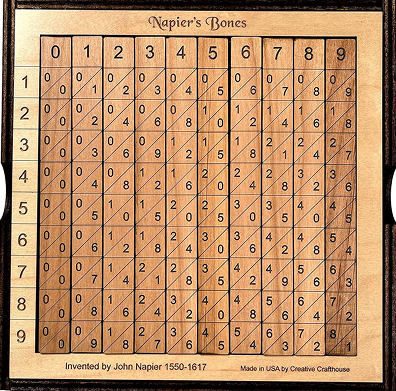
“Computation simplified through lattice multiplication.”
John Napier invented a manually-operated calculating device created from ivory strips (hence "bones") for calculation of products and quotients of numbers.
This invention reduced complex multiplication and division to simple addition and subtraction, paving the way for the slide rule and eventual analog computers.
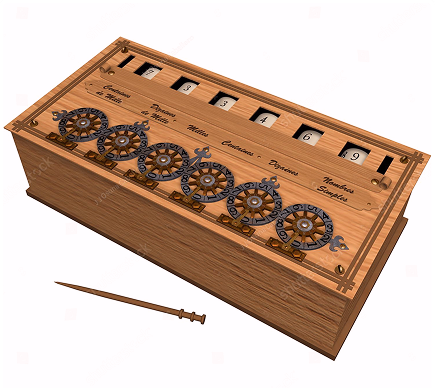
“The dawn of mechanical dreaming.”
Blaise Pascal, at age 19, designed this mechanical calculator to help his father with taxes. It was the first functional mechanical calculator to be produced.
It introduced the carry mechanism for addition, a critical logical step where the revolution of one gear triggers the movement of the next—a principle replicated in mechanical computing for three centuries.
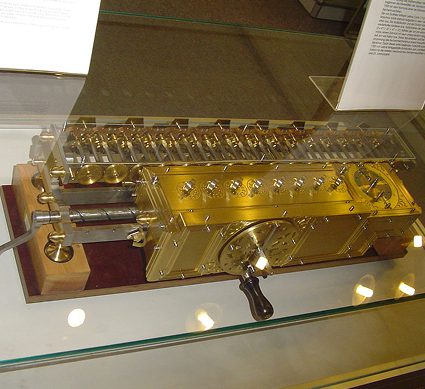
“The first machine to master all four operations.”
Gottfried Wilhelm Leibniz improved upon Pascal's design with his ‘Stepped Reckoner’. It was the first calculator that could perform all four arithmetic operations: addition, subtraction, multiplication, and division.
Its core mechanism, the ‘Leibniz wheel’ or stepped drum, remained the dominant mechanical calculator technology for the next two centuries.
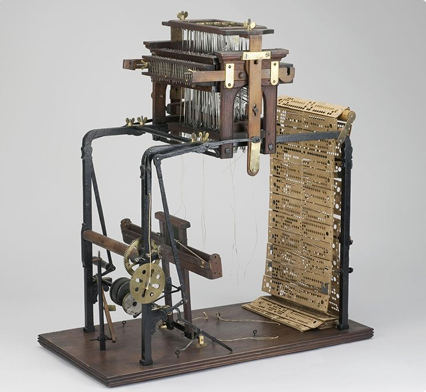
“Weaving the very first threads of code.”
Joseph Marie Jacquard invented a way to control a loom using a series of punched cards, allowing complex patterns to be woven automatically.
The "punched card" system was the first practical application of binary data storage and programming instructions, transforming the textile industry and directly inspiring Charles Babbage's later engines.
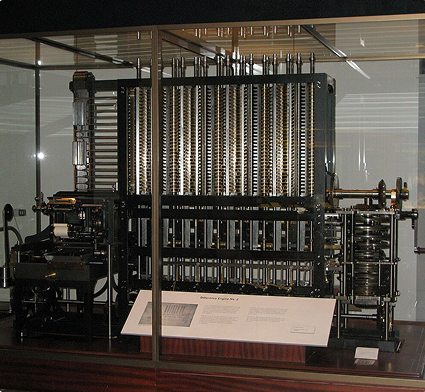
“The grand ambition of error-free tables.”
Designed by Charles Babbage, this was the first mechanical computer designed to automatically calculate and tabulate mathematical functions (polynomials).
Though never fully completed in his lifetime due to funding and precision issues, it demonstrated the feasibility of mechanized calculation on an industrial scale.
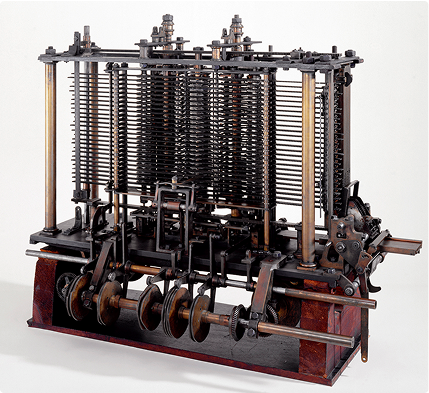
“A cathedral of brass gears.”
Charles Babbage's design was a programmable machine promised to weave algebraic patterns like flowers. It possessed all the essential logical features of the modern general-purpose computer.
Unlike the Difference Engine, this machine was Turing-complete, featuring loops, conditional branching, and separate memory and processing units.
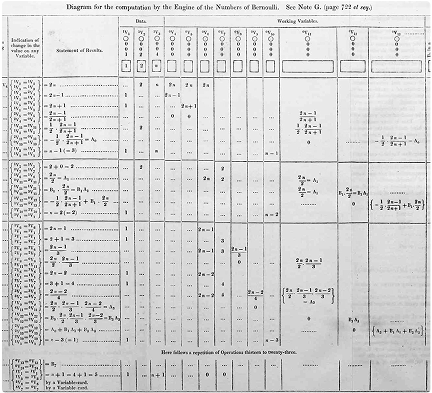
“The first vision of software.”
In her detailed notes on the Analytical Engine, Ada Lovelace described a stepwise sequence of operations for the engine to compute Bernoulli numbers.
She recognized that computers could do more than calculate numbers—they could manipulate any symbol if defined by rules. This insight conceptualized modern computing software long before hardware existed to run it.
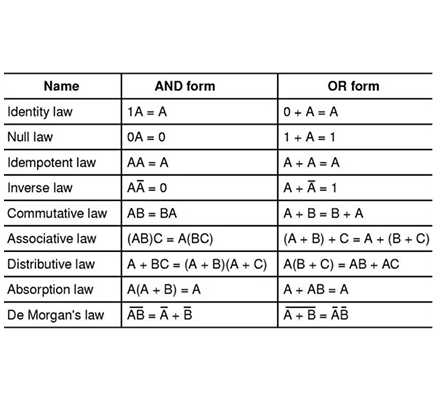
“The mathematics of thought.”
George Boole published "The Laws of Thought" introducing a system of logic where variables are either true (1) or false (0). This algebraic system became the bedrock of digital circuit design.
Nearly a century later, Claude Shannon would prove that this logic could be implemented with electrical switches, bridging abstract mathematics and physical machines.
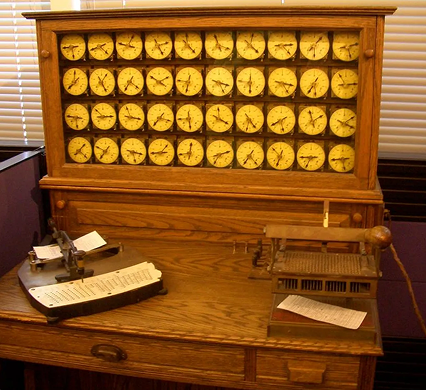
“Data processing on an industrial scale.”
Herman Hollerith developed an electromechanical tabulating machine for the 1890 U.S. Census. It used punched cards to store data, which were then read by electrical sensors.
This success launched the data processing industry. Hollerith's company eventually merged to become IBM, marking the commercial beginning of the computing era.
“The theoretical limit of computation.”
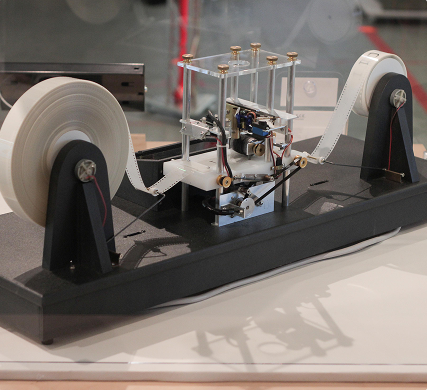
Alan Turing proposed a hypothetical device that could manipulate symbols on a strip of tape according to a table of rules. While a mathematical model, it described the logical principles of every computer built since.
His concept of the "Universal Turing Machine" proved that a single machine could perform any computable task if given the correct instructions (software).
“The quiet dawn of the programmable age.”
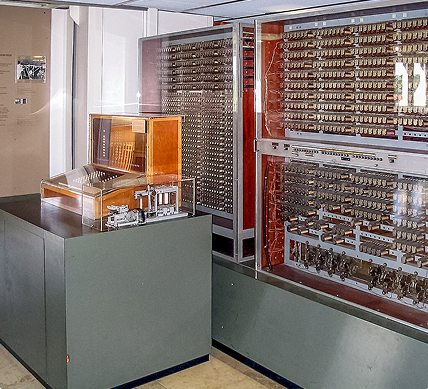
Konrad Zuse completed the Z3 in Berlin during WWII. Built with 2,000 relays, it was the first working programmable, fully automatic digital computer.
Unlike earlier mechanical calculators, the Z3 used binary floating-point arithmetic, a standard still used in modern computing, though its program was stored on punched film tape.
“A giant brain of vacuum tubes.”
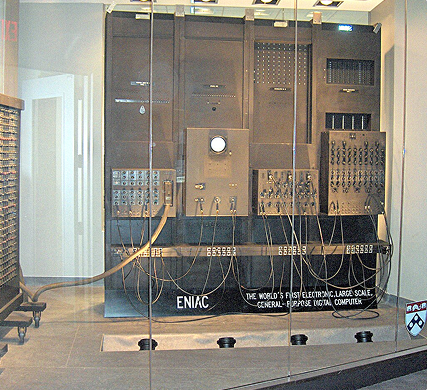
The Electronic Numerical Integrator and Computer (ENIAC) was the first electronic general-purpose digital computer. It was a behemoth, occupying a large room and using 18,000 vacuum tubes.
Its speed was unprecedented—calculating artillery trajectories in seconds rather than hours. It marked the shift from slow mechanical parts to lightning-fast electronic switching.
“The blueprint for a stored-program future.”
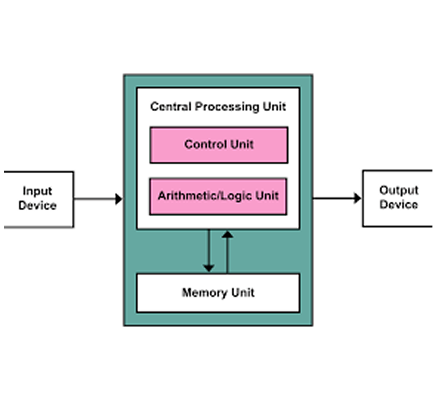
John von Neumann described a computer architecture where data and program instructions are stored in the same memory space. This "stored-program" concept allows computers to be easily reprogrammed without physical rewiring.
This architecture remains the standard design for nearly all computers today, from supercomputers to smartphones.
“The moment software came alive.”
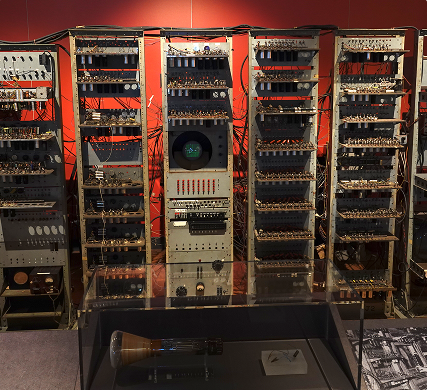
The Small-Scale Experimental Machine (SSEM), nicknamed "Baby," was the world's first electronic stored-program computer. It successfully ran its first program on June 21, 1948.
It was built primarily to prove the viability of the Williams tube for random-access memory, but in doing so, it became the first machine to embody the complete modern computer definition.
From the heavy iron of the Industrial Revolution to the humming vacuum tubes of the first mainframes.
Explore Next Era →