Mobile app development in 2026 is no longer limited to large tech companies. In India, startups, MSMEs, enterprises, and even local businesses are investing in mobile applications to reach users faster, automate operations, and scale digitally. From fintech apps in Bengaluru to eCommerce and logistics platforms in Delhi NCR, mobile apps have become a core business asset.
If you’re searching for how to develop a mobile app, steps to create a mobile app, or what do I need to build an app, this in-depth beginner guide is built specifically for the Indian market. This article explains the mobile app development process, best practices, costs in India, checklists, and what to know about skills app developers before starting a custom app project.
India is one of the world’s fastest-growing app economies. With affordable smartphones, increasing internet penetration, and digital payment adoption, custom mobile apps have become the primary way users interact with brands.

Idea validation is the foundation of successful Custom app development.
Things to know before developing an app: Most apps fail not because of poor development, but due to lack of market demand and unclear value propositions.
| Purpose | Tools |
| Market trends | Google Trends |
| Competitor research | Play Store, App Store |
| User feedback | Surveys, MVP launches |
A clear roadmap saves time, money, and rework.
To start a custom app project, you need:
| Priority | Description |
| Must-have | Core functionality required for launch |
| Good-to-have | Improves usability and engagement |
| Future scope | Planned for later versions |
Choosing the right platform impacts cost, reach, and timeline.
| Platform | Best For | Cost |
| Android | Mass users | Medium |
| iOS | Premium users | Medium |
| Cross-platform | Faster launch | Lower |
Understanding the development process helps you stay in control of your project.
A structured process ensures performance, security, and scalability.
Design directly affects user adoption and retention.

Good UI/UX improves ratings and long-term engagement.
This stage converts designs into a working product.
| Layer | Technologies |
| Frontend | Flutter, React Native |
| Backend | Node.js, Laravel |
| Database | Firebase, MySQL |
| Cloud | AWS, Google Cloud |
Testing ensures your app works as expected.
Skipping testing can lead to poor reviews and user churn.
Launching an app involves more than publishing it.
A strong launch increases visibility and downloads.
App development does not end after launch.
Ongoing maintenance ensures long-term success.
| Development Stage | Cost Range (in USD) |
| UI/UX Design | $1,000 – $3,000 |
| Frontend Development | Depends upon business days |
| Backend Development | Depends upon business days |
| QA & Testing | Depends upon business days |
| Third-Party Integrations | Depends on the API |
| Maintenance & Updates | $350 for month & 15& of total project amount for year |
Costs depend on features, platforms, and integrations.
Before hiring app developers, understand:
Choosing the right development partner is crucial for success.
To develop a custom mobile app in India, you need to start with idea validation, define app goals, choose the right platform (Android, iOS, or cross-platform), design UI/UX, develop the app, test it thoroughly, and launch it on app stores. Post-launch maintenance and updates are essential for long-term success.
In India’s fast-growing digital ecosystem, mobile apps help startups, MSMEs, and enterprises reach users efficiently while supporting UPI payments, multilingual users, and scalable cloud infrastructure.
| App Type | Development Timeline |
| Simple | 3 to 6 months |
| Medium Complex | 9 to 10 months |
| Highly Complex | 12 + months |

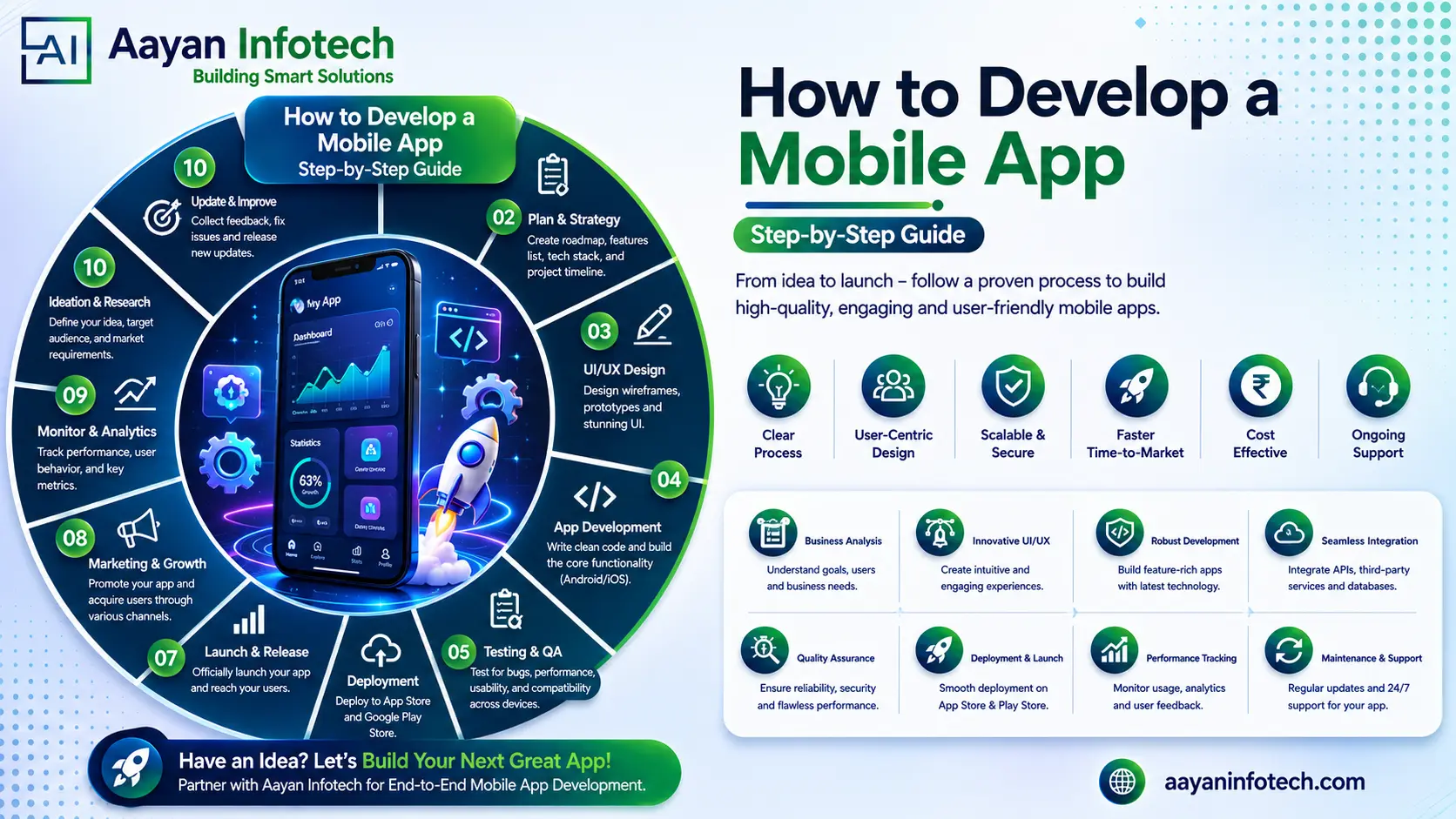
The steps to create a mobile app include discovery and planning, UI/UX design, app development, quality testing, deployment, and ongoing maintenance. Each step ensures the app is secure, user-friendly, and scalable.
Following a structured mobile app development process helps Indian businesses reduce development risks, control costs, and launch faster in competitive markets like fintech, eCommerce, healthcare, and logistics.
To build a mobile app, you need a validated idea, target audience, feature list, budget, platform selection, design wireframes, and a skilled app development team. You also need a post-launch support and scaling plan.
For businesses in India, considering Android-first development, UPI integration, and regional user behavior is critical for building an app that performs well and gains adoption.
Best practices for app development include starting with an MVP, prioritizing user experience, building scalable architecture, ensuring data security, and testing across multiple devices. Regular updates and performance optimization are also essential.
Indian businesses that follow these app development best practices are more likely to achieve higher app store ratings, better user retention, and long-term digital growth.
To start a custom app project, begin with requirement documentation, feature prioritization, timeline planning, and budget estimation. Consulting an experienced mobile app development company early helps avoid costly mistakes.
For startups and enterprises in India, a well-planned custom app project ensures faster execution, better alignment with business goals, and smoother collaboration with app developers.
The mobile app development process includes planning, design, development, testing, deployment, and maintenance. Each phase plays a specific role in ensuring quality and performance.
Understanding this process helps Indian business owners and founders communicate effectively with developers and make informed decisions throughout the project lifecycle.
Before developing a mobile app, you should understand market demand, estimated cost, development timeline, monetization strategy, platform choice, and maintenance requirements.
Many first-time app founders in India overlook post-launch costs and user acquisition strategies, which are critical for long-term app success.
| Region | Hourly Rates of Development |
| UAE | $25 |
| USA | $25 |
| Western Europe | $25 |
| Australia | $25 |
| Eastern Europe | $25 |
| Asia | $25 |
Aayan Infotech is a trusted mobile app development company in India, delivering secure, scalable, and high-performing applications. With experienced developers, a proven development process, and a business-first approach, Aayan Infotech helps startups and enterprises turn ideas into successful mobile apps.
👉 Ready to start your custom app project? Contact Aayan Infotech today for a free consultation. Contact us today at +91 7007120194 or email us at info@aayaninfotech.com.