As a matter of fact, Artificial Intelligence is not in the future anymore, but it is already changing industries in every part of the world and education is in the front-line of revolution. The impact of Artificial Intelligence on learning systems is reshaping how knowledge is delivered, accessed, and evaluated. Since customized learning journeys to smart tutoring tools, the AI future of education offers more revolutionary possibilities than ever before in terms of innovation, efficiency and inclusivity.
With the ever-increasing pace of the digital transformation, AI in education has turned into a mighty change agent, rebranding classical classrooms and facilitating smarter, more dynamically behaving learning environments. This blog describes the opportunities, challenges, and duties that accompany the introduction of AI in education and defines how a middle ground would help to build a more equal future.
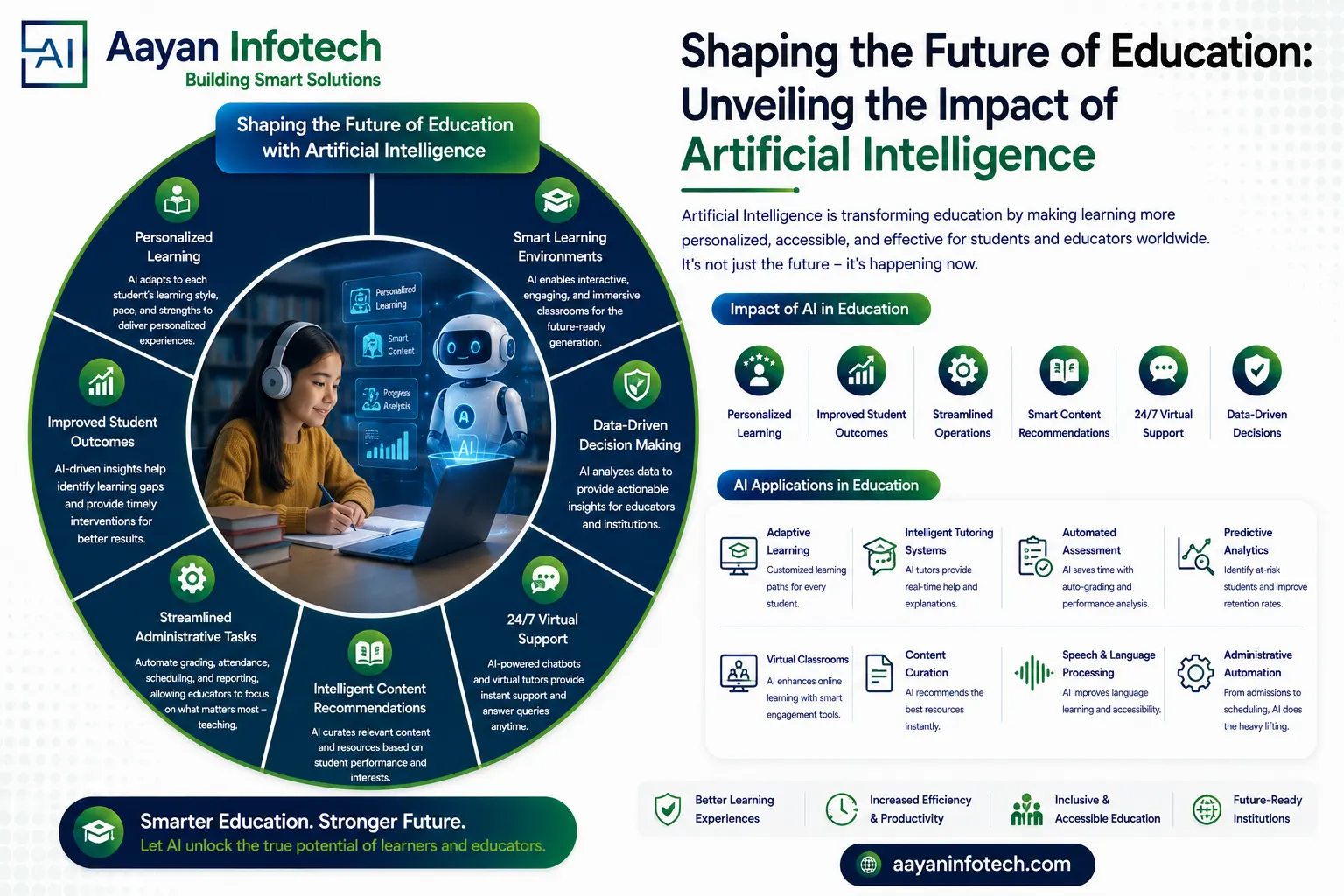
One of the most transformative aspects of the impact of Artificial Intelligence in education lies in its ability to personalize learning. Smart tools with AI will be used to analyze learning rate, strengths, and weaknesses of students and provide them with tailored content. This is an adaptive learning strategy whereby all the students are not left behind and the high performing students are pushed to remain challenged.
Intelligent tutoring systems offer real time feedback enabling the learners to comprehend complicated issues according to their speed of learning. The automated tests minimize the administrative overhead and enable educators to perform additional work in the field of mentoring and creativity instead of doing manual work. AI-supported virtual classrooms provide more data about how students engage and develop.
Moreover, AI in education makes learning immersive using the tools of virtual reality (VR), augmented reality (AR), whereby a student can learn about a historical event, scientific simulation, or elaborate machine in a hands-on style. These technologies are redefining interaction and enhancing retention of knowledge in different and varied learning methods.
While the AI future of education is promising, it also comes with critical challenges that demand careful consideration. Responsible implementation is essential to ensure AI enhances learning without compromising ethical standards.
Data Privacy Reigns Supreme
The AI systems used in education are dependent on data about students. This leaves the questions of data privacy, data security and consent behind. Academic records, behavioral data and personal identifiers are sensitive information that should be guarded in their misuse or breach.
It is essential to make sure that the international data protection laws are met, and clear data-processing measures are undertaken to ensure that trust is ensured. Learner rights should be ensured through secure infrastructure and ethical governance of data being handled in institutions.
Although AI can make the process more effective, excessive reliance on automated systems can minimize human interaction, which is a critical component of the education process. Machines will never be capable of doing critical thinking, emotional intelligence, creativity and empathy with full capacity.
It is essential to achieve the balance between AI-enhanced tools and teacher-centered instructions. AI must be a helper, not a substitute and must help the educator instead of stripping him of his position.
To fully realize the impact of Artificial Intelligence in education, a strategic and inclusive approach is required—one that places people, ethics, and accessibility at its core.
AI tools can empower educators by automating routine tasks such as grading, attendance tracking, and performance analysis. This frees up valuable time for lesson planning, personalized mentoring, and skill development.
Professional development programs focused on AI literacy can help teachers effectively integrate technology into their classrooms, ensuring they remain central to the learning experience.
Ethics is an important concept in Artificial Intelligence in the field of educational training. The AI systems should be made transparent, explainable, and accountable. There is need to ensure that algorithmic bias is tackled at its core by developers and institutions so that students of all kinds can have equal and affirmative results.
Discrimination can be addressed with the help of ethical AI systems and regular observations and allow technology to serve educational generations with educational values.
It takes more than the application of technology to prepare students to the AI future of education, it includes knowing it. Students should be taught about AI functionality, its weaknesses, and effects on society through digital literacy programs.
The school environment fostering AI awareness will result in knowledgeable users and future innovators, who will be able to find their way in an ever-more automated world in a responsible manner.
The problem of technology is also another huge obstacle in most areas. Unless the infrastructure is proper, the advantages of AI in education will continue to benefit privileged groups.
Close to the digital divide, affordable devices, internet access, and inclusive platforms are needed so that all people are able to receive equal opportunities in learning.
The future of AI in education will have to rely on the cooperation of the educators, policymakers, technologists, parents and students. This transparency helps to bring out a variety of views and therefore an outcome that is viable, morally correct, and effective.
The process of sustaining innovation in learning ecosystems will be motivated by shared responsibility and continuous feedback.
Conclusion
The impact of Artificial Intelligence on education is profound and far-reaching. However, used in a responsible manner, AI can change the learning process, enable teachers, and design more inclusive educational methods. The AI future of education can be molded into a driver of long-term positive change by considering the issues of ethics, privacy, and accessibility.
Aayan Infotech build powerful, intelligent AI systems — from ChatGPT-like chatbots to enterprise-grade Large Language Models (LLMs) — tailored to your business needs. You can contact us through our website’s contact form, email us at info@aayaninfotech.com, or call us directly at +91 7007120194.
Visit here: Happy New Year 2026: Top 5 Holiday Destinations in India
Will AI replace teachers?
No, AI will not replace teachers. Instead, it will support educators by automating repetitive tasks and providing insights that enhance teaching effectiveness. Human guidance, creativity, and emotional intelligence remain irreplaceable.
How will AI handle the digital divide in education?
AI alone cannot solve the digital divide, but it can be part of the solution. Combined with inclusive policies, affordable technology, and infrastructure development, AI can help extend quality education to underserved communities.
Can AI be biased?
Yes, AI can be biased if trained on unbalanced or flawed data. This is why ethical development, regular audits, and diverse datasets are critical to ensure fairness and inclusivity in educational AI systems.
What are the ethical considerations of using AI in education?
Key ethical concerns include data privacy, transparency, accountability, bias, and the responsible use of student data. Addressing these issues is essential for building trust and ensuring ethical AI adoption.
What can we do to prepare for the future of AI in education?
Preparing for the future involves investing in digital literacy, training educators, establishing ethical AI guidelines, and promoting collaboration among stakeholders. A proactive approach ensures AI enhances education responsibly and sustainably.