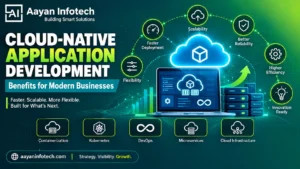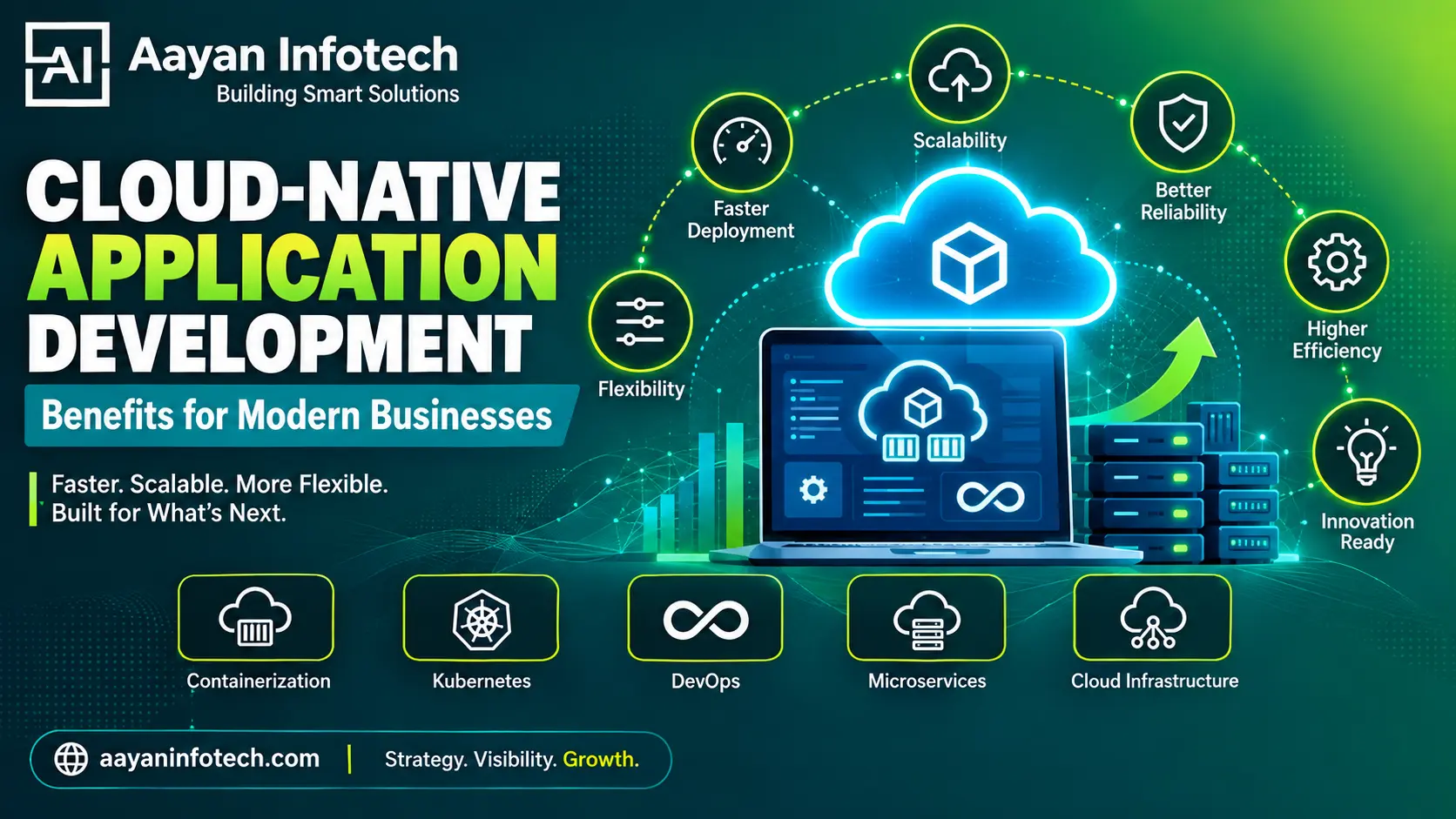
Modern businesses need software that can scale with demand, adapt to changing customer expectations, and remain reliable as technology evolves. Cloud-Native Application Development provides an architecture and development approach designed around these requirements.
For startups, growing companies, and enterprises, Cloud-Native Application Development can support faster releases, flexible scaling, improved resilience, and more efficient infrastructure management. NIST describes cloud-native applications as commonly using loosely coupled microservices, containers, orchestration, and supporting service infrastructure.
For businesses working with a technology partner, the right approach is not simply choosing the newest cloud technology. The architecture should be selected according to business objectives, application requirements, security needs, data sensitivity, expected traffic, and long-term maintenance requirements.
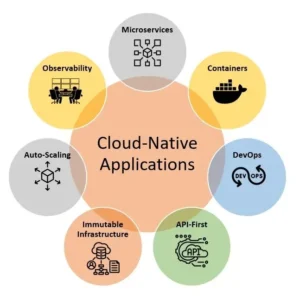
Cloud-Native Application Development is the process of designing, building, deploying, and operating applications specifically to take advantage of cloud computing environments.
A cloud-native application may use:
NIST explains that cloud-native architectures commonly use loosely coupled microservices, frequently implemented as containers, together with infrastructure that supports application services. This approach allows individual application components to be developed, deployed, monitored, and scaled independently when the architecture calls for it.
Cloud-native development is more than hosting an application on AWS, Azure, or another cloud platform. The application architecture and development lifecycle are designed around flexibility, automation, scalability, and resilience.
Developers first determine whether a monolithic, modular, microservices, serverless, or hybrid architecture is appropriate. Microservices can divide a larger application into smaller services that communicate through APIs or other service mechanisms. This can make individual components easier to update and scale.
However, microservices are not automatically the best choice for every project. A smaller business application may be more efficient with a well-designed modular architecture.
Containers package application code and its dependencies into portable units. This can provide consistency between development, testing, and production environments and can simplify deployment across infrastructure.
NIST notes that containers can support rapid scale-out scenarios because application instances can be created and removed as demand changes.
CI/CD automation can connect code changes with automated testing, security checks, packaging, and deployment. This helps development teams release improvements more frequently while reducing repetitive manual deployment tasks. NIST’s DevSecOps guidance describes CI/CD pipelines as workflows that move source code through stages such as building, testing, packaging, deployment, and operations.
Cloud-native systems can contain many services and dependencies. Monitoring therefore needs to go beyond checking whether a server is online.
Teams may monitor:
Good observability helps teams identify performance problems and operational issues earlier.
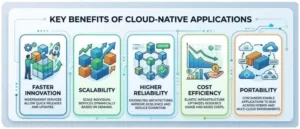
One of the major advantages of Cloud-Native Application Development is the ability to scale application resources according to workload requirements. For example, an eCommerce platform may experience significantly higher traffic during promotions. A cloud-native architecture can be designed so that specific services can scale independently rather than requiring the entire application to scale in the same way. This can help businesses handle variable workloads more efficiently.
Cloud-native development commonly works with automated CI/CD pipelines. Instead of waiting for large, infrequent software releases, teams can introduce smaller changes through controlled deployment processes.
This can help businesses:
The result is a development process that can be more responsive to changing business requirements.
Cloud-native architecture can be designed to reduce the impact of individual component failures. For example, if one service experiences an issue, architectural patterns such as isolation, redundancy, health checks, retries, and controlled traffic management can help prevent the failure from affecting the entire system. Resilience still depends on implementation quality. Simply using containers or cloud infrastructure does not automatically make an application highly available.
Cloud-native applications can integrate different technologies according to the requirements of individual services. A development team may use different programming languages, databases, APIs, or supporting services where there is a clear technical reason. This flexibility can be useful for large enterprise applications and complex digital platforms.
Cloud environments allow businesses to provision computing resources according to application requirements. Instead of maintaining fixed infrastructure for every possible traffic level, businesses can design systems that respond to changing workloads.
Cloud-native architecture can therefore support more flexible infrastructure planning, although actual cost savings depend on architecture, workload, cloud pricing, monitoring, and resource management.
Security should not be treated as a final step before deployment.
Cloud-native development can integrate security throughout the development lifecycle through:
NIST’s cloud-native guidance emphasizes the importance of security and DevSecOps practices for modern microservices-based applications.
Traditional applications can still be effective, particularly for smaller systems and stable business requirements. The difference is primarily in architecture, deployment, infrastructure management, and operational practices.
| Area | Traditional Approach | Cloud-Native Approach |
| Architecture | Often monolithic | Often modular or microservices-based |
| Scaling | Frequently application-wide | Can be service-specific |
| Deployment | More manual in some environments | Highly automated |
| Infrastructure | Often fixed or manually managed | Elastic and programmable |
| Releases | Larger release cycles | Smaller, automated releases |
| Monitoring | Server/application focused | Distributed observability |
| Resilience | Often centralized | Designed across components |
| Infrastructure management | Manual or semi-automated | Infrastructure as Code and automation |
The correct choice depends on the project. Cloud-native is not automatically better for every application.
Cloud-Native Application Development can be particularly useful when a business needs:
For a small internal application with limited users and stable requirements, a simpler architecture may provide better value. The key is to select architecture based on business requirements instead of following technology trends.
Businesses in India increasingly need software platforms that can support both local and international users. For companies searching for a software development company in Lucknow, cloud-native architecture can be considered for SaaS platforms, enterprise applications, customer portals, marketplaces, mobile backends, business automation platforms, and other systems with changing workloads.
Aayan Infotech has an India office in Lucknow, Uttar Pradesh, and provides custom software, AI, web, mobile, cloud, and enterprise technology services. For businesses expanding beyond India, a cloud-based architecture can also support applications designed for users across regions such as the USA, Middle East, Europe, and Australia.
However, geographic expansion also requires careful planning around latency, data residency, security, compliance, disaster recovery, and infrastructure costs.
Aayan Infotech provides custom software development services covering requirements analysis, design, development, testing, deployment, and ongoing support. Its existing service information also references cloud deployment options such as AWS and Microsoft Azure.
A practical cloud-native project can follow a structured process:
The first stage identifies business objectives, users, workflows, integrations, security requirements, expected traffic, and scalability requirements.
The technical team determines whether a monolithic, modular, microservices, serverless, or hybrid architecture is appropriate.
Developers build APIs, application services, databases, interfaces, and integrations according to the approved architecture.
Testing can include unit, integration, performance, security, and user acceptance testing.
The application is deployed to the selected cloud environment using appropriate infrastructure and deployment automation.
After launch, application performance, infrastructure utilization, security events, errors, and user experience should be continuously monitored.
This lifecycle helps businesses treat cloud infrastructure as part of the overall software engineering strategy rather than simply as a hosting destination.
Security needs to be designed into the architecture from the beginning.
Important areas include:
NIST notes that cloud-native applications can involve many distributed services and inter-service communications, making data protection and access control important architectural considerations.
Businesses handling financial, healthcare, customer, or other sensitive information should also evaluate applicable regulatory and contractual requirements before selecting their cloud architecture.
Depending on the project, a cloud-native technology stack may include:
The technology stack should be selected according to application requirements rather than keyword popularity.
Choosing the right architecture can have a long-term impact on application performance, scalability, security, development speed, and operating costs. Cloud-Native Application Development should therefore begin with business requirements and technical discovery not with a predetermined technology stack.
Aayan Infotech works with businesses on custom software, cloud engineering, AI, web and mobile applications, APIs, and enterprise technology solutions. If you are planning a new cloud-native platform or modernizing an existing application, the next step is to evaluate your current architecture, business goals, scalability requirements, and technology roadmap.
Talk to Aayan Infotech about your application requirements and request a technical consultation.