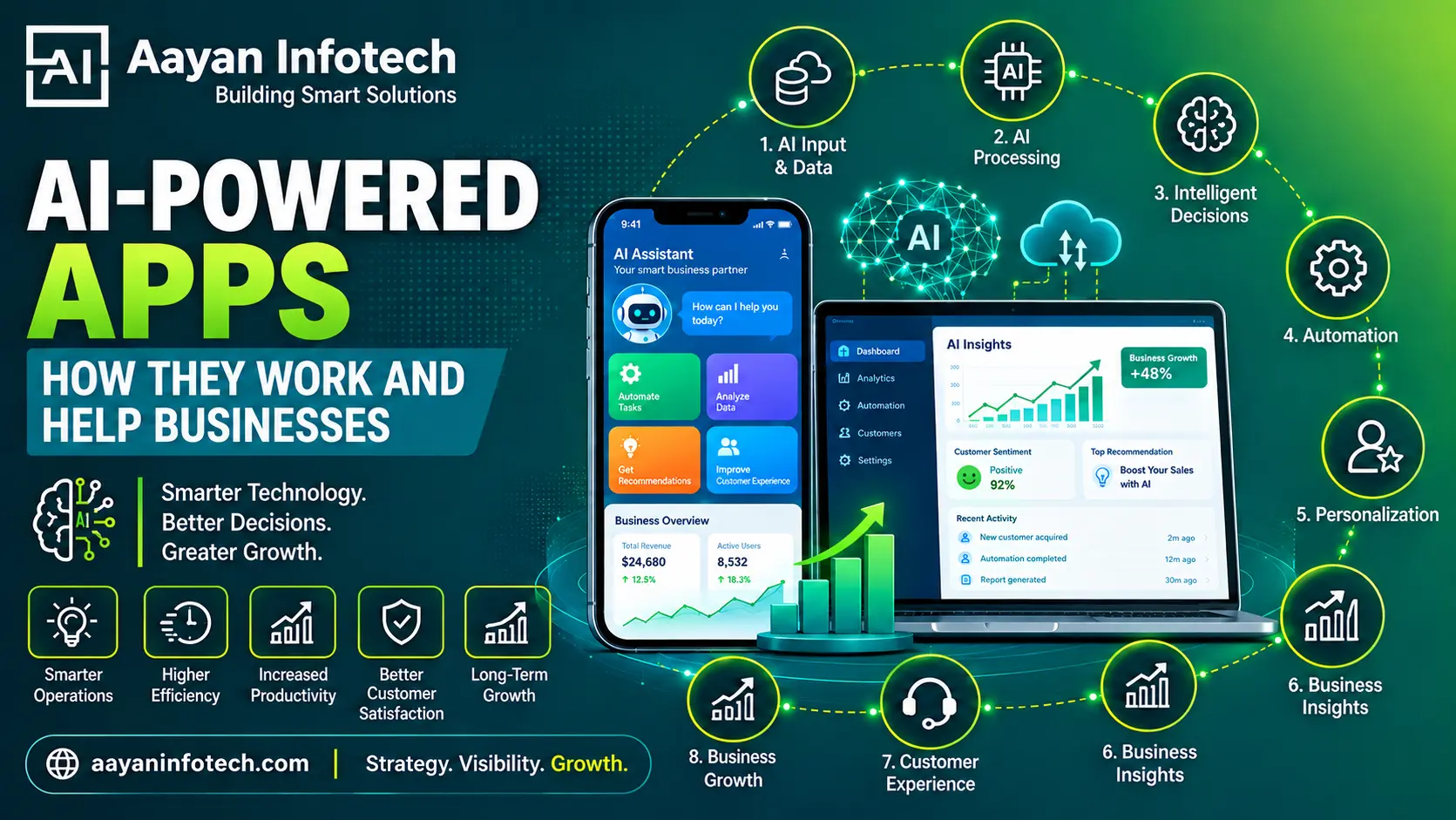
Businesses are moving beyond traditional software toward intelligent systems that can understand requests, make decisions, use business data, and complete tasks. An Agent Application takes this idea further by combining artificial intelligence, large language models, business data, APIs, automation, and workflow management into an application that can act toward a defined business goal.
Unlike a basic chatbot that mainly responds to questions, an AI agent can interpret a request, determine the steps required, use connected tools, retrieve information, and complete actions. Google Cloud describes AI agents as software systems that use AI to pursue goals and complete tasks on behalf of users.
For companies looking to improve productivity, customer service, sales, operations, or decision-making, agent-based applications can become an important part of a modern digital strategy.
An Agent Application is an AI-powered software application designed to understand a user’s goal and take actions to achieve it.
A traditional application usually waits for a user to select options, enter information, and follow predefined steps. An AI agent can handle more flexible requests by understanding natural language and determining what actions are needed.
For example, a customer could ask:
“Check my order status and tell me when it is expected to arrive.”
Instead of simply displaying a generic FAQ, an AI agent could identify the customer’s order, access the order-management system through an API, retrieve the latest shipping information, and provide an answer.
Depending on how the system is designed, the agent may also initiate an approved action, such as updating a ticket, scheduling an appointment, preparing a report, or sending information to another business system.
This makes agent applications particularly useful for businesses that manage repetitive but decision-oriented workflows.
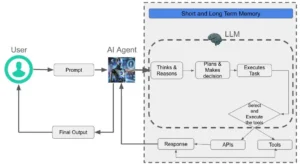
An Agent Application generally combines several technical components. Google Cloud identifies models, grounding, tools, data architecture, orchestration, and runtime as important building blocks of modern AI agents.
The process begins when a customer, employee, or business user provides a request through a website, mobile app, internal platform, voice interface, or another digital channel.
The AI model interprets the request and identifies the user’s objective.
For example:
“Find three available meeting slots with our sales team next week and prepare an invitation.”
The system needs to understand the task rather than simply match a keyword.
The agent determines which steps are required to complete the request.
It may need to:
This planning capability is one of the major differences between a conventional chatbot and an agentic application.
An AI agent needs reliable information to produce useful results.
Business knowledge can come from:
Grounding helps an agent retrieve relevant information rather than relying only on the model’s general knowledge.
An agent becomes significantly more useful when it can interact with other software.
For example, an AI sales agent could connect with:
These integrations allow the agent to move from simply generating text to performing useful business operations.
After understanding the task and gathering the required information, the agent can execute an approved action. For example, an ecommerce agent could identify a customer’s order, check inventory, create a support ticket, and notify the customer. For sensitive activities such as payments, account changes, or important business decisions, human approval and appropriate access controls should be built into the workflow.
Production AI agents require monitoring, testing, security controls, and performance measurement. Modern agent platforms increasingly provide observability and governance capabilities because organizations need to understand what an agent did, which tools it used, and whether the task was completed successfully.
The terms chatbot and AI agent are sometimes used interchangeably, but they can represent different levels of functionality.
| Traditional Chatbot | Agent Application |
| Primarily responds to questions | Understands goals and performs tasks |
| Usually follows predefined flows | Can plan multi-step workflows |
| Limited system access | Can use approved tools and APIs |
| Mainly conversational | Conversational and action-oriented |
| Often handles simple support | Can automate complex business processes |
| Limited decision-making | Can apply business rules and workflows |
A chatbot may answer, “What is your return policy?”
An agent could potentially answer the question and then help the customer start the return process through an integrated workflow.
The exact capabilities depend on the application’s architecture, permissions, integrations, and business rules.
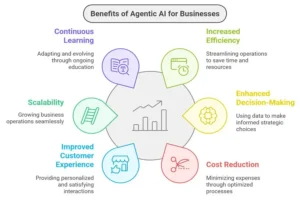
Businesses are adopting AI-powered applications because they can support both customer-facing and internal processes.
Employees often spend considerable time handling repetitive tasks such as data entry, information retrieval, customer queries, report preparation, and status updates. An agent can automate portions of these workflows and allow employees to focus on higher-value work.
An AI agent can provide assistance across websites, mobile applications, and other digital channels. It can answer questions, retrieve customer information, guide users through processes, and escalate complex cases to human representatives. This can create a faster and more consistent customer experience.
An internal AI agent can act as a digital assistant for employees.
For example, an employee could ask:
“Summarize this month’s sales performance and identify the regions that need attention.”
The application could retrieve approved business data, analyze it, and prepare a useful summary.
Agent applications can combine AI reasoning with business data to help teams access relevant information faster. They can support reporting, forecasting, research, analytics, and operational workflows. AI should not automatically replace human judgment in important decisions. Instead, businesses should design systems where humans can review, approve, or override important actions.
Once a workflow is properly designed and monitored, AI agents can help organizations handle larger volumes of routine requests without increasing manual effort at the same rate. Cloud infrastructure can also provide scalable environments for different types of agent workloads.
An Agent Application can be designed around a specific business process or industry requirement.
Healthcare organizations can use AI applications for administrative workflows, appointment assistance, patient information retrieval, and internal knowledge support. Sensitive information requires strict privacy, security, access control, and compliance measures.
Financial organizations can use intelligent applications for document processing, customer support, research assistance, reporting, and workflow automation. High-risk financial decisions should include appropriate human oversight and governance.
An ecommerce AI agent can help customers discover products, answer product questions, check order status, and support returns. It can also connect with inventory and customer-management systems.
Real estate businesses can use AI agents to qualify inquiries, answer property questions, schedule appointments, summarize listings, and route leads to sales teams.
A logistics agent can assist with shipment updates, delivery information, documentation, scheduling, and internal operational workflows.
Technology companies can deploy AI agents for technical support, onboarding, internal knowledge management, documentation, and customer success.
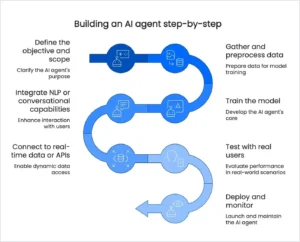
Building an effective agent requires more than connecting an AI model to a chatbot interface.
Start with a specific problem.
Instead of saying, “We want an AI agent,” define a measurable objective such as:
Identify what happens before, during, and after the AI agent receives a request.
Document:
Depending on the use case, the solution may involve an LLM, retrieval-augmented generation, APIs, databases, workflow orchestration, vector search, or multiple specialized agents.
Google’s current agent ecosystem supports both low-code and code-first development approaches for building AI agents.
Secure integrations allow the application to retrieve information and perform approved actions. Access should follow the principle of least privilege, meaning the agent receives only the permissions necessary for its role.
Not every task should be fully autonomous.
Human approval can be valuable for:
Test the application with real-world scenarios, edge cases, incorrect inputs, incomplete information, and potential security risks. Measure accuracy, task completion, latency, cost, user satisfaction, and escalation rates.
After launch, continue monitoring performance. Agent applications should be evaluated as business systems rather than treated as one-time software projects.
Aayan Infotech provides AI and machine learning application development services for businesses looking to create intelligent digital products. Its AI development capabilities include custom AI solutions, natural language processing, predictive analytics, computer vision, and recommendation systems.
For organizations in Lucknow, Uttar Pradesh, India, as well as businesses serving customers across international markets, the development process can be aligned with specific operational requirements.
A successful agent project should begin with the business workflow rather than the technology alone. Aayan Infotech can help businesses evaluate the use case, design the application architecture, integrate AI with existing systems, develop the required interfaces, and prepare the solution for production.
Businesses can also explore Aayan Infotech’s AI & Machine Learning Application Development Services and learn more about the company through its About Us page.
An Agent Application can turn AI from a simple question-and-answer tool into a practical business system capable of understanding requests, retrieving information, using tools, and supporting multi-step workflows.
The biggest opportunity is not simply adding AI to an existing application. It is identifying business processes where intelligent automation can create measurable value. Companies should start with a clearly defined problem, reliable data, secure integrations, appropriate human oversight, and measurable outcomes.
For businesses in India, Dubai, Saudi Arabia, the USA, and other global markets, a well-designed AI agent can support customer experience, productivity, automation, and digital transformation. If your business is exploring an Agent Application, start with the workflow you want to improve and the business result you want to achieve.
Ready to turn an AI idea into a working business solution? Contact : Aayan Infotech to discuss your requirements and explore a custom AI application for your organization.