
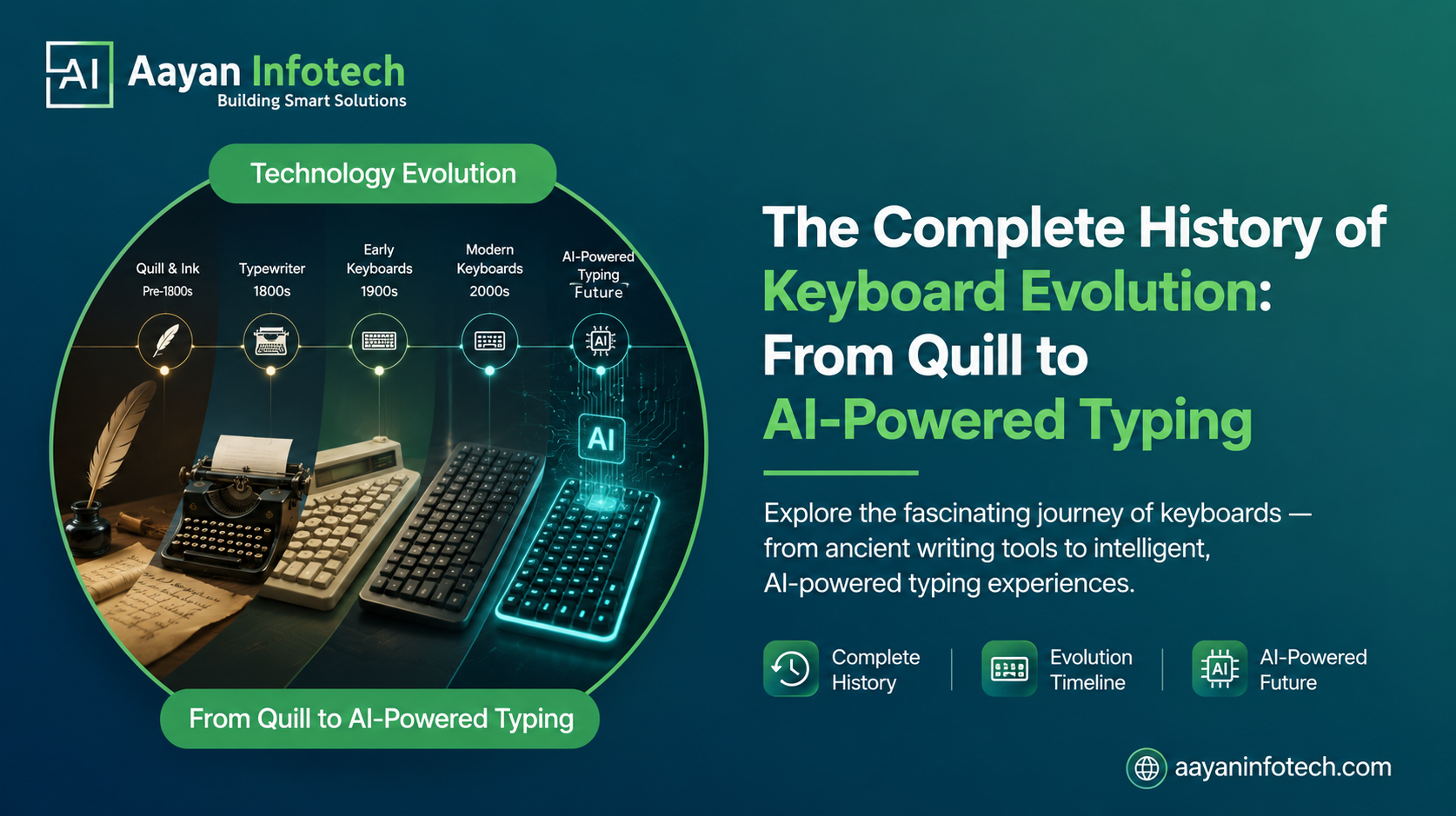
| Era | Key Development |
| Pre-1800s | Handwriting and printing press |
| 1870s | Mechanical typewriter + QWERTY layout |
| 1920s–1950s | Electric typewriters, IBM innovation |
| 1960s–1980s | Computer keyboards, IBM Model M |
| 1990s–2000s | Internet boom, mechanical keyboard revival |
| 2010s–present | Gaming culture, custom keyboards, RGB |
| Future | AI, holographic, gesture, neural interfaces |
How the humble keyboard became humanity’s most powerful communication tool and where it’s headed next.
The keyboard sitting in front of you right now carries centuries of evolution. From ink-stained quills to holographic interfaces, the history of keyboard evolution is really the story of humanity’s relentless desire to communicate faster, smarter, and more expressively. Whether you’re a tech enthusiast, a history buff, or simply curious about the tools you use every day, this deep dive into the evolution of keyboards will change how you look at every keystroke.
Before the keyboard was invented, ideas traveled at the speed of a hand. Every letter, every document, every business transaction was handwritten — one painstaking word at a time. The printing press changed distribution, but content creation remained slow and labor-intensive.
Inventors in the industrial age began dreaming of machines that could type. Society’s growing demand for faster communication — driven by commerce, journalism, and governance — made the need for a typing machine urgent. This was the spark that ignited one of the most transformative inventions in modern history.
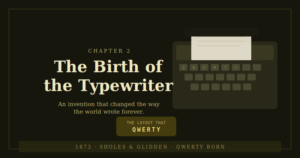
In the 1860s, inventor Christopher Latham Sholes set out to build a machine that could type faster and more reliably than human hands. His early prototypes faced a critical mechanical problem: when typists moved too quickly, the letter arms would collide and jam.
His elegant solution? The QWERTY keyboard layout designed specifically to slow typists down just enough to prevent key jams. Counterintuitive as it sounds, this layout worked brilliantly. The Sholes & Glidden typewriter (1873), widely regarded as the first practical typewriter, brought this layout to the masses.
Typewriters didn’t just change how people wrote, they transformed entire industries. Offices, newsrooms, and law firms hired a new wave of professional typists. For the first time, typing became a career, not just a task. Despite dozens of competing keyboard layouts emerging over the decades, QWERTY outlasted them all and remains the global standard to this day.
Fun fact: The QWERTY layout was never updated after key jams became obsolete; it simply became too embedded in culture to replace.

By the early 1900s, inventors began replacing raw muscle power with electric motors. Electric typewriters made typing faster, quieter, and far less physically demanding. IBM led this revolution with innovations like the IBM Model D (1923) a landmark in speed, reliability, and design.
New key mechanisms reduced noise and improved accuracy, making the electric typewriter the undisputed king of the mid-20th century office. Businesses scaled rapidly. Communication, documentation, and productivity soared to new heights.
The journey from the mechanical typewriter to the electric typewriter wasn’t just a technical upgrade — it was a shift in the culture of work itself. Offices transformed. Secretarial roles multiplied. And in hindsight, the electric typewriter laid the essential groundwork for the digital keyboard revolution that was soon to follow.
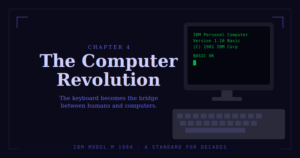
The arrival of computers in the mid-20th century gave the keyboard an entirely new purpose. As terminals and mainframes became central to business operations, keyboards became the primary interface between humans and machines.
The rise of minicomputers and then personal computers in the 1970s and 80s made keyboards accessible to everyday people. New key types emerged — function keys, Escape, Control, and arrow keys — dramatically expanding how users could interact with software.
The IBM Model M keyboard (1984) became a legend during this era. Tactile, durable, and incredibly reliable, it set the standard that enthusiasts still chase today. As the personal computer moved from corporate offices into homes and schools, the keyboard became a universal tool — no longer the domain of professional typists alone.
Key milestones in PC keyboard evolution:
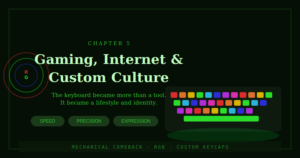
The internet didn’t just connect the world, it transformed the keyboard from a productivity tool into a cultural artifact. Emails, instant messaging, forums, and social media put keyboards at the center of human connection. Billions of keystrokes every day became the heartbeat of digital life.
Then gaming arrived and raised the stakes dramatically. Competitive gamers demanded faster response times, greater durability, and pinpoint precision. The keyboard industry answered. Mechanical switches made a powerful comeback, celebrated for their tactile feel, satisfying sound, and exceptional lifespan compared to the rubber dome switches that had dominated office keyboards.
This era also sparked a global custom keyboard community — one of tech’s most passionate subcultures:
Today, a custom keyboard can cost hundreds — sometimes thousands — of dollars. For many enthusiasts, it’s not just a device. It’s identity.
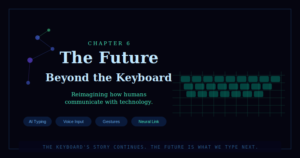
We may be standing at the most exciting inflection point in keyboard history. The next chapter isn’t simply about better keys, it’s about reimagining how humans communicate with technology altogether.
Here’s what the future of input technology looks like:
AI-Powered Typing Smart AI assistants already predict, autocomplete, and suggest text in real time. Tomorrow’s keyboards may write with you — learning your style, anticipating your intent, and generating content as you type.
Voice Typing 2.0 Advanced speech recognition with real-time multilingual translation is breaking language barriers. Speaking naturally and having it appear instantly as text is no longer science fiction.
Gesture and Air Typing Hand movements, eye tracking, and gesture recognition are turning the air itself into a workspace. No physical surface required.
Brain-Computer Interfaces Thought-to-text neural interfaces — where neural signals translate directly into written words — could make traditional keyboards invisible entirely.
Holographic and Foldable Keyboards Project a keyboard onto any surface. Roll it up and carry it in your pocket. Adaptive layouts that change based on what you’re doing — coding, writing, gaming — are already emerging.
Sustainable and Inclusive Design Future keyboards will be built to be eco-friendly, adaptive to different physical needs, and genuinely accessible to everyone.
“Keys may change. Technology will evolve. But the purpose remains the same : to connect, to express, to create.”
Understanding the complete history of keyboard evolution gives us more than trivia; it gives us perspective. Every time you type, you’re using a tool that was refined across 150+ years of human ingenuity. The keyboard has survived the transition from mechanical to electric, from analog to digital, and from physical to virtual.
More than just an input device, the keyboard has always been humanity’s voice connecting ideas to people, people to businesses, and individuals to cultures across the globe.
Innovation never stops. The keyboard will keep evolving. But its core purpose of empowering human expression will never change.