Artificial Intelligence (AI) is revolutionizing nearly every industry, but its impact on medicine is especially profound. AI in Healthcare is transforming how diseases are diagnosed, treatments are personalized, hospitals are managed, and patients receive care. From detecting cancer in medical images to enabling virtual health assistants and accelerating drug discovery, AI has become a powerful tool for improving healthcare outcomes.
Healthcare systems worldwide face growing challenges, including aging populations, physician shortages, rising costs, and increasing patient expectations. AI in Healthcare offers innovative solutions by automating routine tasks, enhancing diagnostic accuracy, supporting clinical decision-making, and improving operational efficiency. Rather than replacing healthcare professionals, AI empowers them with advanced insights that lead to better patient care.
In this guide, you’ll learn how AI in Healthcare works, its practical applications, benefits, challenges, real-world examples, and what the future holds for AI-driven medical innovation.
AI in Healthcare refers to the use of artificial intelligence technologies such as machine learning, deep learning, natural language processing (NLP), and computer vision to improve healthcare services, support medical professionals, and enhance patient outcomes.
Unlike traditional healthcare software that follows fixed rules, AI systems continuously learn from large datasets. This enables them to identify patterns, predict outcomes, recommend treatments, and automate repetitive tasks with increasing accuracy.
Healthcare organizations use AI for various purposes, including:
Today, AI in Healthcare is no longer an experimental technology. It is actively used by hospitals, research institutions, insurance providers, and healthcare technology companies around the world.
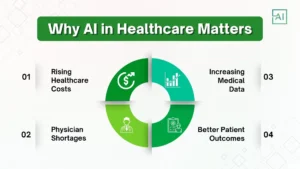
Healthcare systems are under constant pressure to deliver high-quality care while reducing costs and improving efficiency. Several global trends have accelerated the adoption of AI in Healthcare.
Healthcare expenses continue to increase due to aging populations, chronic diseases, and advanced medical treatments. AI helps reduce unnecessary costs by automating administrative tasks, improving diagnostic accuracy, and minimizing hospital readmissions.
Many countries face shortages of healthcare professionals. AI-powered tools assist doctors by analyzing patient data, prioritizing cases, and providing decision support, allowing clinicians to focus on complex medical care.
Modern healthcare generates enormous amounts of data through electronic health records, laboratory reports, imaging systems, wearable devices, and genomic research. AI processes these datasets efficiently, uncovering insights that humans may overlook.
AI enables earlier disease detection, personalized treatment plans, and continuous patient monitoring. These capabilities contribute to improved clinical outcomes and enhanced patient satisfaction.
Understanding how AI in Healthcare functions helps explain why it has become a critical component of modern medicine.
AI systems analyze massive datasets, identify patterns, learn from previous outcomes, and make predictions or recommendations. As more data becomes available, these systems continuously improve their accuracy.
The AI workflow generally includes:
Machine learning enables computers to identify patterns from historical medical data without being explicitly programmed.
Healthcare applications include:
Machine learning models improve over time as they process larger datasets.
Deep learning is an advanced form of machine learning that uses artificial neural networks to analyze highly complex healthcare data.
Its capabilities include:
Deep learning has significantly improved diagnostic accuracy in radiology and pathology.
Healthcare professionals generate millions of clinical notes every day. Natural Language Processing enables AI to understand and analyze unstructured medical text.
Common NLP applications include:
NLP reduces documentation time and improves healthcare efficiency.
Computer vision allows AI systems to interpret visual medical information.
Applications include:
Computer vision helps physicians detect abnormalities that may be difficult to identify manually.
Predictive analytics combines AI with statistical modeling to forecast future healthcare events.
Examples include:
Predictive healthcare enables proactive treatment instead of reactive care.
| Technology | Primary Healthcare Use |
| Machine Learning | Disease prediction |
| Deep Learning | Medical imaging |
| NLP | Clinical documentation |
| Computer Vision | Diagnostic imaging |
| Predictive Analytics | Risk assessment |
| Robotics | Precision surgery |
| Generative AI | Medical documentation |
Artificial intelligence is no longer limited to research laboratories. Today, AI in Healthcare is transforming hospitals, clinics, diagnostic centers, pharmaceutical companies, and home healthcare services.
Some of the most impactful applications include:
AI assists healthcare professionals by analyzing patient symptoms, laboratory results, imaging scans, and medical histories to detect diseases more accurately and quickly.
Examples include:
By reducing diagnostic errors, AI supports earlier intervention and better patient outcomes.
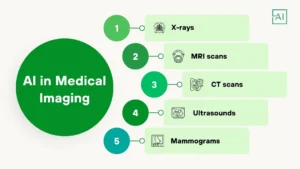
Medical imaging is one of the most successful applications of AI in Healthcare.
AI algorithms can analyze:
These systems help radiologists identify abnormalities faster while reducing interpretation time.
Developing a new drug is a lengthy and expensive process that can take more than a decade. AI in Healthcare is changing this by helping pharmaceutical companies identify promising drug candidates, predict their effectiveness, and optimize clinical trials.
AI analyzes vast amounts of biological, chemical, and clinical data to discover patterns that researchers might miss. This significantly reduces the time required for early-stage drug development.
During global health emergencies, AI has also helped researchers analyze viruses, identify treatment options, and accelerate vaccine research.
Every patient is unique, and treatments that work well for one individual may not produce the same results for another. AI in Healthcare enables personalized medicine by analyzing genetic information, lifestyle factors, medical history, and laboratory data.
Instead of using a one-size-fits-all approach, AI helps doctors create customized treatment plans tailored to each patient.
This approach improves treatment effectiveness while reducing unwanted side effects.
Modern robotic surgical systems use artificial intelligence to assist surgeons during complex procedures.
Although surgeons remain in complete control, AI enhances precision by providing real-time guidance and analyzing surgical data.
AI-assisted robotic surgery is increasingly used in cardiology, urology, gynecology, and orthopedic procedures.
Remote patient monitoring has become increasingly important, especially for managing chronic diseases.
Wearable devices and smart sensors continuously collect health data such as:
AI analyzes this information and alerts healthcare providers when abnormal patterns appear.
Patients can receive timely care without frequent hospital visits.
Telemedicine has expanded rapidly over the past few years, and AI in Healthcare plays a major role in making virtual care more efficient.
AI-powered telemedicine platforms offer:
These tools improve access to healthcare, especially for people living in rural or underserved communities.
Beyond clinical care, AI helps hospitals improve operational efficiency.
Healthcare administrators use AI to optimize daily operations such as:
Reducing administrative work allows healthcare professionals to spend more time caring for patients.
The growing adoption of AI in Healthcare offers significant advantages for healthcare providers, patients, and researchers.
AI can analyze thousands of medical records and imaging scans within seconds, helping doctors make quicker diagnoses.
Machine learning models reduce diagnostic errors by identifying subtle patterns that may be difficult for humans to detect.
Earlier diagnosis and personalized treatments lead to improved recovery rates and enhanced quality of care.
Healthcare professionals spend less time on repetitive administrative tasks and more time interacting with patients.
Automation reduces unnecessary testing, minimizes hospital readmissions, and improves resource allocation.
AI-powered virtual assistants and telemedicine services make healthcare more accessible to patients in remote locations.
Wearable devices provide real-time health monitoring, enabling early intervention before serious complications develop.
Despite its many benefits, AI in Healthcare also presents several important challenges.
Healthcare organizations manage highly sensitive patient information.
Strong cybersecurity measures, encryption, and regulatory compliance are essential to protect patient privacy.
AI models are only as good as the data used to train them.
If training datasets lack diversity, AI systems may produce inaccurate or biased recommendations for certain patient populations.
Healthcare AI solutions must comply with strict regulations before being adopted in clinical settings.
Organizations must demonstrate safety, effectiveness, and transparency.
Many hospitals still rely on older information systems.
Integrating AI with existing healthcare infrastructure can require significant investment and technical expertise.
Healthcare providers must ensure AI supports, not replaces, human judgment.
Patients should understand how AI contributes to medical decisions, and clinicians should remain responsible for final treatment choices.