Financial technology has transformed how people manage money, invest, and make payments. Digital banking, mobile wallets, and AI-driven financial services now shape the global economy. Businesses across India and United States invest heavily in modern financial solutions to remain competitive.
Companies that build reliable financial platforms gain customer trust, improve efficiency, and unlock new revenue streams. However, building a secure financial product requires careful planning, strong architecture, and strict compliance.
This comprehensive guide explains the FinTech Product Development playbook. It covers the step-by-step process, challenges, solutions, and business benefits for organizations planning to launch a fintech product. Technology development teams at Aayan Infotech follow this approach to deliver scalable fintech platforms for startups and enterprises worldwide.
What is FinTech Product Development?
FinTech Product Development refers to the process of designing, building, and launching digital financial platforms such as payment apps, lending systems, and digital banking solutions. The process includes market research, regulatory compliance, architecture design, secure development, testing, and ongoing operations.

Financial services now depend on digital platforms. Customers expect fast payments, secure transactions, and instant financial insights.
A strong FinTech Product Development strategy helps companies:
Businesses in India and the United States face intense competition in digital finance. Traditional banking models no longer meet modern customer expectations. Financial institutions must adopt digital platforms that deliver secure and seamless experiences. Organizations that invest in modern fintech solutions often gain a strong competitive advantage.
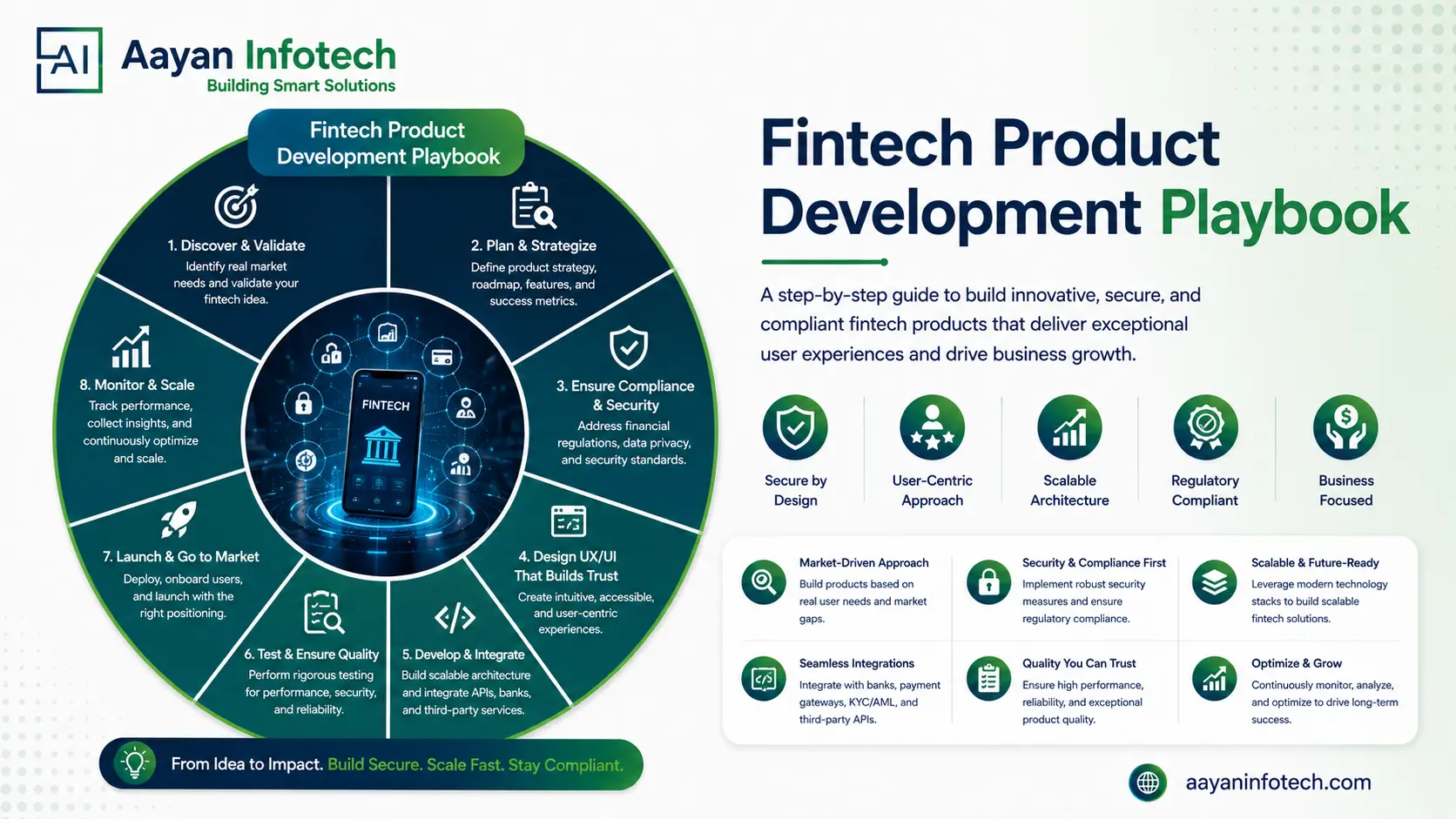
Building a reliable financial platform requires a structured approach. Each stage plays a crucial role in the product lifecycle.
Every fintech product must align with market demand and regulatory rules.
Start by researching:
Financial authorities regulate digital financial services strictly. Businesses must comply with regulations such as Reserve Bank of India guidelines and policies from the U.S. Securities and Exchange Commission. Early regulatory analysis reduces legal risks and avoids costly redesigns.
Clear product planning prevents unnecessary complexity.
Define:
Product managers often create a Minimum Viable Product (MVP) before launching a full platform. This approach allos businesses to validate ideas and gather user feedback quickly.
Fintech systems must handle millions of transactions safely.
A strong architecture should support:
Cloud-based systems and microservices architecture help developers build resilient financial platforms.
Security should never become an afterthought.
Financial products must include:
Compliance frameworks ensure that the platform meets international standards and protects customer data.
Large fintech systems require multiple integrations.
Developers integrate:
Teams must test each module carefully before moving to the next stage.
This approach reduces integration failures and improves system stability.
Launching a fintech product marks only the beginning.
Successful platforms require:
Operational readiness ensures that the platform performs well under real-world conditions.
Fintech innovation introduces many technical and regulatory app development challenges.
Financial systems depend on multiple third-party integrations.
Examples include:
Developers should use API-first architecture to simplify integrations and reduce risks.
Fintech projects involve multiple teams, including:
Strong collaboration ensures that every team works toward the same product vision.
Organizations that adopt digital finance platforms gain several advantages.
Modern financial products provide faster transactions and real-time financial insights.
Automation reduces manual processes and operational costs.
Fintech platforms collect valuable financial data that improves decision making.
Digital financial products open new revenue streams through subscriptions, transaction fees, and financial services.
Fintech solutions allow businesses to serve international customers more efficiently.

A successful fintech platform must include several critical capabilities.
Strong identity verification prevents unauthorized access.
Reliable payment infrastructure ensures smooth transactions.
Advanced analytics detect suspicious activities quickly.
Encryption protects financial data during storage and transmission.
Real-time insights help users monitor financial activity.
Flexible APIs allow easy integration with external financial services.
Fintech innovation now supports multiple industries and Aayan Infotech has developed in multiple industries projects.
Mobile banking applications offer secure account management and digital payments.
Digital payment systems allow businesses to process transactions quickly.
Investment platforms provide automated portfolio management.
Digital lending systems streamline loan approvals and credit assessments.
InsurTech solutions simplify policy management and claim processing.
Several global platforms demonstrate the impact of fintech innovation.
These platforms prove that strong architecture and user-focused design create successful fintech products
Financial products must maintain high levels of security and regulatory compliance.
Key frameworks often include:
Security and compliance teams should participate from the earliest design phase.
Early planning reduces regulatory risks and protects financial data.
Developing financial platforms requires deep technical expertise and regulatory understanding. Aayan Infotech delivers reliable fintech software development solutions for startups, enterprises, and financial institutions.
Their services include:
The development team focuses on security, scalability, and compliance to ensure that fintech products perform reliably in global markets. Organizations across India and the United States rely on Aayan Infotech to build innovative financial technology solutions. You can reach out via info@aayaninfotech.com, or call us at +91 7007120194.