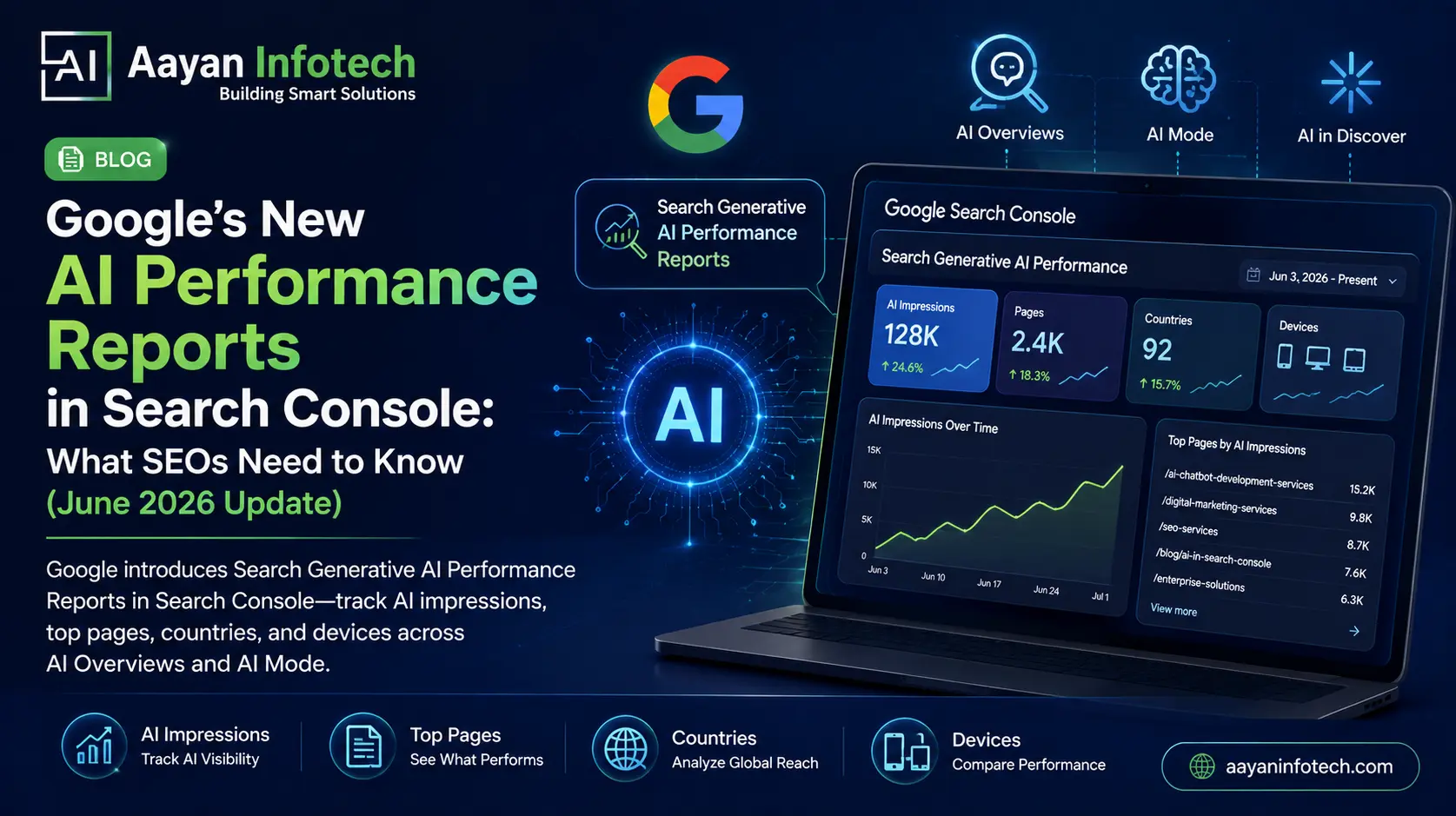
Google has officially taken another major step in the evolution of AI-powered search. Google introduced Search Generative AI Performance Reports in Search Console on June 3, 2026, giving website owners and SEO professionals a dedicated way to measure their visibility across AI-driven search experiences.
The new reports provide insights into how content appears within Google’s generative AI features, including AI Overviews, AI Mode, and AI-powered experiences in Discover. Until now, businesses had limited visibility into how often their content was surfaced by Google’s AI systems. With this update, Google is bringing greater transparency by allowing site owners to track AI impressions, analyze performance by page, country, and device, and better understand their presence in AI-generated search results.
As AI continues to reshape how users discover information online, these reports represent a significant milestone for both SEO (Search Engine Optimization) and GEO (Generative Engine Optimization). They provide the data needed to evaluate AI visibility, identify optimization opportunities, and build content strategies that align with the future of search.
At Aayan Infotech, we believe this update will become one of the most important Search Console enhancements of 2026, helping businesses adapt to the growing influence of generative AI in search and content discovery.
Google has officially launched Search Generative AI Performance Reports inside Search Console. These reports help website owners understand how their pages perform within AI-generated search experiences, including AI Overviews and AI Mode.
Previously, marketers relied on indirect methods to estimate AI visibility. Now, Google provides dedicated reporting that offers greater transparency into AI-driven search performance.
This update helps businesses understand:
The new reporting framework supports better decision-making for SEO and content optimization.
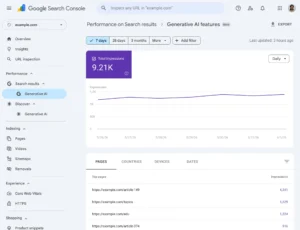
Google’s Search Generative AI Performance Reports are dedicated reporting sections within Search Console that track content visibility inside Google’s AI-powered search features.
These reports focus on exposure rather than traditional search rankings.
The reports provide data about:
The feature bridges the gap between traditional SEO metrics and AI-driven search performance.
Google’s Search Generative AI Performance Reports are Search Console reports that show how often content appears in AI-powered search experiences, including AI Overviews and AI Mode. The reports track AI impressions, pages, countries, and devices to help businesses measure AI search visibility.
Google designed these reports to provide actionable insights.
Users can now monitor how often Google’s AI systems display their content.
This metric helps identify content that gains visibility within AI-generated responses.
The report highlights pages receiving AI impressions.
Marketers can quickly identify content that performs well in AI search environments.
Businesses can analyze AI visibility across different regions.
This feature helps international brands understand market-specific performance.
The report separates data by device categories.
Users can compare AI visibility across:
Google categorizes data based on AI-powered search experiences.
This structure helps users understand where AI systems surface their content.
Accessing the report is straightforward.
Follow these steps:
Google may gradually roll out access across accounts. Some users may receive the feature earlier than others.

The update introduces several valuable metrics.
AI impressions show how often Google’s AI systems reference or display your content.
This metric serves as the primary indicator of AI visibility.
Page reporting identifies URLs appearing within AI-generated search experiences.
High-performing pages reveal content formats favored by AI systems.
Country reports highlight geographic performance patterns.
Businesses can use this information to improve regional content strategies.
Device reporting shows where users encounter AI-generated search experiences.
Understanding device trends can guide content formatting decisions.
Search behavior continues to evolve.
Users increasingly interact with AI-generated answers instead of traditional search results. This shift makes AI visibility a critical performance metric.
Traditional SEO focuses on rankings and clicks.
AI reporting adds another layer of measurement by showing visibility within AI-generated experiences.
Generative Engine Optimization aims to increase content inclusion in AI-generated answers.
These reports provide direct feedback on GEO efforts.
Marketers can identify:
This data enables smarter optimization strategies.

AI visibility requires a different approach than traditional ranking optimization.
Create content that demonstrates real expertise.
Include:
AI systems prefer content that directly answers search queries.
Use:
Google values:
Showcase author credentials and cite reliable sources.
Organize content with:
Voice search and AI search often rely on natural language.
Write content that mirrors how people speak and ask questions.
Although the update is valuable, it has limitations.
The most notable limitation involves click tracking.
Currently, Google does not provide:
Users can only monitor visibility through impressions.
This limitation makes it difficult to measure direct traffic impact from AI-generated search experiences.
Future updates may introduce additional engagement metrics.
Businesses should act quickly to capitalize on these insights.
Review pages receiving strong AI visibility.
Identify patterns that contribute to success.
Create additional content around themes already performing well in AI search.
Enhance content quality, structure, and topical depth.
Use country data to tailor regional content strategies.
Mobile usage continues to dominate search behavior.
Ensure content remains easy to read across all devices.
AI search continues to evolve rapidly.
Regular monitoring helps businesses adapt faster than competitors.
The launch of Google’s Search Generative AI Performance Reports represents a major milestone for SEO professionals.
For years, marketers lacked visibility into AI-powered search experiences. Google now provides meaningful data that helps businesses understand their presence in AI search environments.
While the reports currently focus on impressions rather than clicks, they offer valuable insights into how AI systems interact with content.
Organizations that combine SEO, GEO, and E-E-A-T best practices will gain a competitive advantage as AI search expands.
At Aayan Infotech, we recommend regularly monitoring these reports and adjusting content strategies in response to emerging AI visibility trends. Businesses that embrace AI search optimization today will position themselves for stronger digital growth tomorrow.