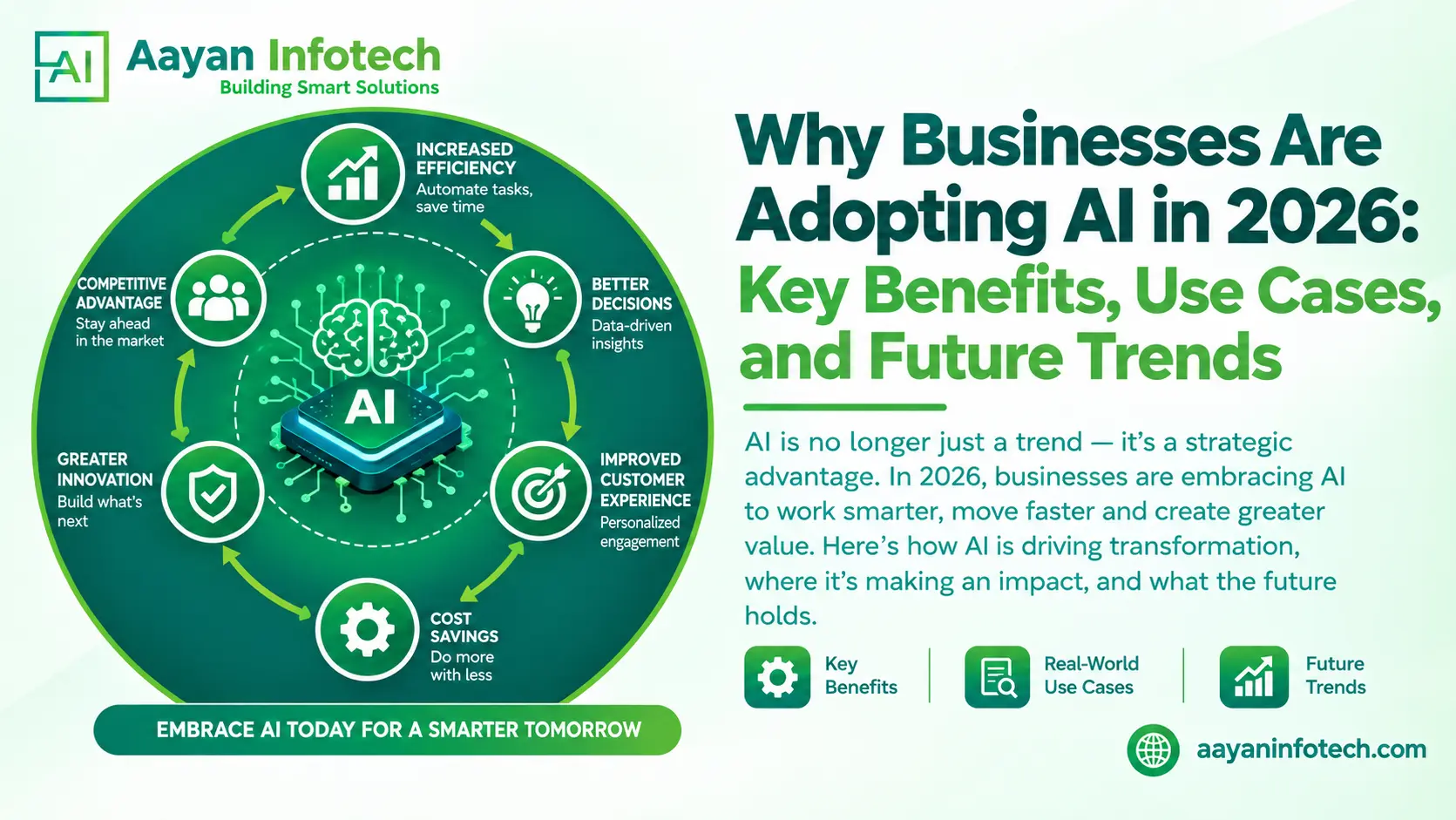
Artificial intelligence is changing how companies manage operations, serve customers, analyse information, and compete in digital markets. AI adoption in business is becoming an important part of digital transformation as organisations look for practical ways to improve productivity, reduce repetitive work, and make better decisions. From small businesses to large enterprises, AI-powered technology is creating new opportunities across industries.
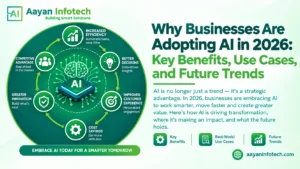
In 2026, businesses are moving beyond experimenting with AI tools and exploring how artificial intelligence can support everyday workflows. According to the Stanford HAI AI Index Report 2026, organisational AI use continued to grow in 2025, with 88% of surveyed organisations reporting AI use in at least one business function. This highlights the growing role of AI in modern business operations.
For companies planning their next stage of growth, understanding AI benefits, practical applications, and emerging trends can help them make informed technology investments.
AI adoption in business refers to integrating artificial intelligence technologies into business processes, products, services, and decision-making systems. These technologies enable organisations to analyse data, recognise patterns, automate routine activities, and generate useful insights.
Common AI technologies include machine learning, natural language processing, computer vision, predictive analytics, and generative AI.
Businesses can use these technologies to improve customer support, forecast demand, identify operational problems, personalise marketing campaigns, and assist employees with everyday tasks.
For example, an online retailer might use AI to recommend products based on customer behaviour. A software company could use AI-powered assistants to support developers, while a financial services business might use machine learning to identify unusual transaction patterns.
The right approach depends on business objectives, available data, existing systems, and the problems an organisation wants to solve.

Several factors are encouraging companies to integrate artificial intelligence into their operations.
Many organisations manage repetitive tasks that consume employee time. Data entry, document classification, appointment scheduling, and routine reporting can slow down important work.
AI automation for businesses can reduce manual effort by handling suitable repetitive activities. Employees can then focus on customer relationships, problem-solving, planning, and other responsibilities that require human judgement.
Automation works best when processes are clearly defined and results can be measured. Businesses should identify bottlenecks before selecting tools rather than automating inefficient processes without reviewing them.
Companies collect information through websites, customer relationship management systems, sales platforms, and operational software. However, large volumes of data can be difficult to analyse manually.
AI-powered business tools can identify patterns, summarise information, and help teams interpret complex datasets. These insights can support planning, inventory management, customer segmentation, and performance analysis.
Human review remains important because AI-generated insights may contain errors or reflect incomplete data.
Customers often expect quick responses, relevant recommendations, and convenient digital experiences.
AI-powered chatbots and virtual assistants can answer common questions, guide website visitors, and help customers find relevant information. Personalisation systems can also suggest products, services, or content based on available customer preferences.
These applications can improve service accessibility, but businesses should provide clear escalation options when customers need human assistance.
Businesses are increasingly evaluating technology to improve their ability to respond to market changes.
AI can support faster research, more efficient workflows, and data-informed planning. Companies that introduce suitable AI business solutions may improve specific processes and respond more effectively to changing customer needs.
However, adopting AI alone does not guarantee a competitive advantage. Results depend on implementation quality, employee adoption, data readiness, and alignment with business goals.
The benefits of AI for businesses extend across customer service, operations, marketing, software development, and strategic planning.
AI can help employees draft documents, summarise meetings, organise information, and complete routine digital tasks. These capabilities can reduce time spent on repetitive activities.
For example, a marketing team can use generative AI to create an initial content outline, while employees review the information, improve the messaging, and ensure accuracy.
Business process automation can reduce some manual workloads and minimise avoidable errors. AI-assisted document processing, support ticket classification, and workflow management can make routine operations more efficient.
Cost savings are not automatic. Businesses should account for software subscriptions, integration, maintenance, training, and ongoing monitoring when calculating the overall return on investment.
AI-driven decision-making helps teams examine historical information, detect trends, and evaluate possible outcomes.
Retail businesses can use demand forecasts to support inventory planning. Sales teams can analyse customer engagement, while operations managers can investigate recurring delays.
AI should support decisions rather than replace professional judgement, especially when choices have significant financial, legal, or customer consequences.
AI systems can analyse relevant customer interactions to help businesses deliver more tailored recommendations and communications.
Personalisation can improve product discovery, campaign relevance, and customer engagement when based on appropriate, reliable data.
Organisations should respect customer privacy and applicable data protection requirements when collecting and processing personal information.
AI for business growth can help organisations manage increasing workloads without relying entirely on additional manual processes.
For example, an AI assistant can help a support team handle common enquiries, while an analytics system can highlight potential sales opportunities.
These capabilities can support expansion, but sustainable growth still requires strong products, effective management, customer trust, and sound commercial decisions.
Business AI use cases vary according to industry, workflow, and organisational needs. The following examples illustrate where AI can provide practical value.
Customer service teams can use AI chatbots to answer frequently asked questions, provide basic product information, and route complex enquiries to the appropriate team.
AI can also summarise conversations and help agents locate relevant information more quickly.
Marketing teams can use AI for audience analysis, content planning, campaign insights, and lead prioritisation.
Sales teams may use predictive analytics to identify promising opportunities and understand customer engagement patterns. Employees should verify AI-generated content and ensure that customer communications remain accurate and appropriate.
AI-assisted systems can classify invoices, extract information from documents, identify unusual transactions, and support financial forecasting.
Human approval and appropriate financial controls remain essential for sensitive transactions and reporting.
Healthcare organisations can explore AI for administrative workflows, document processing, scheduling, and analysis of approved clinical data.
Applications involving diagnosis or treatment require appropriate clinical oversight, validation, privacy safeguards, and compliance with relevant regulations.
Manufacturers can use predictive maintenance models to identify equipment patterns that may indicate a potential fault.
Logistics teams can apply forecasting and route-planning tools to support inventory decisions, delivery planning, and resource allocation.
Software development teams can use AI coding assistants for code suggestions, documentation, test generation, and debugging support.
Developers must review generated code, check for security vulnerabilities, and test changes before deploying them into production systems.

Several developments are shaping how organisations evaluate and implement artificial intelligence.
Generative AI is increasingly being applied to writing, research, summarisation, coding, and knowledge management.
Rather than treating it only as a standalone chatbot, businesses are exploring ways to integrate these capabilities into existing applications and workflows.
AI agents are designed to complete sequences of tasks toward a defined goal, sometimes interacting with multiple software tools.
Potential applications include preparing reports, organising support requests, and assisting with internal workflows. Organisations should begin with controlled use cases and establish permission limits, approval checkpoints, and monitoring.
Businesses are increasingly interested in integrating AI with customer relationship management systems, enterprise software, analytics platforms, and internal knowledge bases.
This approach can reduce disconnected workflows and make relevant information easier to access. Integration quality and data consistency are important to achieving reliable results.
As AI adoption expands, data privacy, security, transparency, and accountability are becoming important considerations.
The NIST AI Risk Management Framework provides guidance for organisations seeking to identify and manage risks associated with AI systems.
Businesses should establish clear usage policies, protect confidential information, test outputs, and maintain appropriate human oversight.
An important trend is the shift towards evaluating whether AI improves meaningful business outcomes.
Organisations should measure indicators such as processing time, customer satisfaction, error rates, employee productivity, and operational costs. These measures help determine whether a project deserves further investment.
A structured implementation process can help organisations reduce risk and identify useful opportunities.
Step 1: Identify a specific business problem. Choose a process that consumes time, creates delays, or produces recurring errors.
Step 2: Evaluate data readiness. Check whether the required information is accurate, accessible, secure, and suitable for the intended use.
Step 3: Select the right AI solution. Compare available tools or consider custom AI development when existing products cannot meet specific requirements.
Step 4: Run a pilot project. Test the solution with a limited workflow before introducing it across the organisation.
Step 5: Train employees. Explain how the system works, when human review is necessary, and how to report unexpected results.
Step 6: Measure performance. Compare results against the original baseline and review cost, quality, security, and user feedback.
Step 7: Improve and scale. Expand successful applications gradually while maintaining monitoring, documentation, and accountability.
Although artificial intelligence offers opportunities, businesses should understand the limitations before investing.
A practical AI strategy addresses these challenges from the beginning rather than treating them as problems to resolve after deployment.

Businesses looking to integrate artificial intelligence need technology solutions that align with their operational goals, existing systems, and long-term plans.
Aayan Infotech provides technology development services that businesses can explore when planning digital transformation and custom software projects.
Depending on project requirements, AI-related development may include intelligent workflow automation, AI-powered applications, business software integration, and tailored digital solutions.
Before starting a project, organisations should define their objectives, identify the required data, assess security needs, and establish measurable success criteria.
Companies seeking an AI development partner in India or a technology team supporting international business requirements can discuss their project needs with Aayan Infotech.
Ready to explore AI opportunities for your business?
Contact Aayan Infotech to discuss your business requirements and evaluate suitable AI solutions for improving efficiency, automating repetitive tasks, and supporting business growth. Visit https://aayaninfotech.com/ or email info@aayaninfotech.com to discuss your project.
AI adoption in business is becoming an important part of how organisations improve workflows, analyse information, support customers, and plan for growth. In 2026, generative AI, intelligent automation, AI agents, and integrated business tools are creating new possibilities across industries.
However, successful implementation requires more than choosing the latest technology. Businesses need clear objectives, reliable data, employee training, security controls, and measurable performance targets.
Companies that approach AI strategically can identify practical opportunities, test solutions responsibly, and build a stronger foundation for future digital transformation. Working with an experienced technology partner can help organisations evaluate their requirements and develop solutions aligned with their business goals.