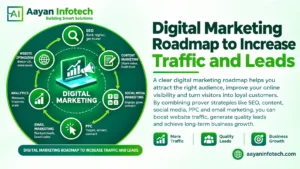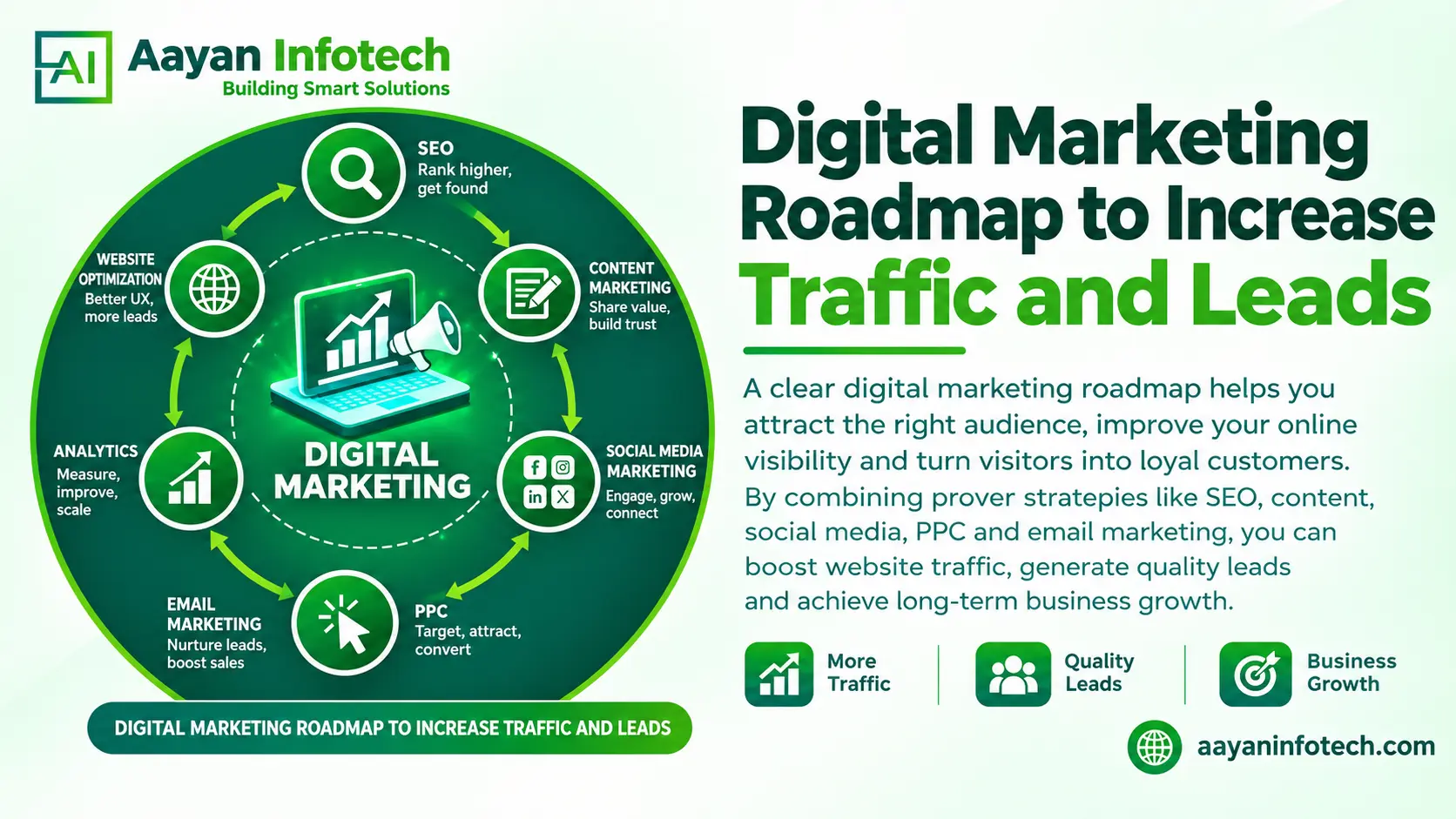
A digital marketing roadmap gives businesses a clear direction for promoting their products or services online. It helps them identify their target audience, select suitable marketing channels, and set realistic goals. By combining SEO, content creation, social media, and paid advertising within a planned strategy, businesses can attract relevant visitors, improve online visibility, and generate more qualified leads. Regularly reviewing campaign results also helps them understand what works and make better marketing decisions.
For businesses in India, a well-planned digital marketing strategy can improve online visibility, attract relevant visitors, and create more opportunities to generate leads. Search engine optimization (SEO), content marketing, social media marketing, and paid advertising can work together to support sustainable business growth.
Aayan Infotech helps businesses explore digital solutions that support their online growth objectives. With a clear digital marketing plan, companies can identify what needs improvement, prioritize their marketing activities, and measure the results.
In this guide, we explain how to build a practical digital marketing roadmap to increase website traffic and generate qualified leads.
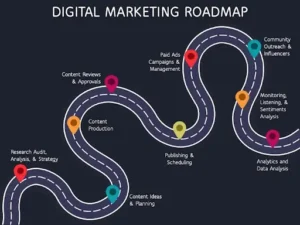
A digital marketing roadmap is a structured plan that outlines the marketing activities a business will use to achieve its online goals. It identifies the target audience, marketing channels, content requirements, timelines, budget, and key performance indicators (KPIs).
Unlike an unplanned approach, a roadmap connects each marketing activity to a measurable business objective.
For example, a company that wants more enquiries may focus on improving service pages, publishing useful blog content, running targeted advertising campaigns, and optimizing contact forms.
A practical roadmap should answer five questions:
A digital marketing strategy helps businesses make informed decisions about where to invest their time and budget. Without a clear strategy, companies may publish content inconsistently, target irrelevant keywords, or spend money on campaigns that do not generate meaningful enquiries.
A well-defined strategy can help businesses:
The goal is not simply to increase traffic. It is to attract the right visitors and make it easy for them to take the next step.
Start by setting clear goals for your business. Instead of focusing only on improving online visibility, identify specific targets, such as increasing website traffic, generating leads, or boosting sales. Clear objectives help you measure progress and understand whether your digital marketing efforts are producing the desired results.
Your objectives might include increasing organic website visits, generating service enquiries, improving landing-page conversions, or reducing the cost per lead.
Choose KPIs that match each objective. For example, organic clicks and search impressions can help measure search visibility, while qualified enquiries and conversion rates can help evaluate lead generation.
Record your current performance before making changes. This baseline will help you understand whether your marketing activities are producing progress.
Effective marketing begins with understanding potential customers. Research their needs, questions, problems, buying preferences, and decision-making process.
Consider the following questions:
Use customer conversations, website analytics, search queries, and sales feedback to develop audience profiles.
For businesses targeting customers in India, audience needs may differ by industry, region, language, and budget. Your messaging should reflect those differences instead of relying on a single generic approach.
Your website should provide a clear, accessible, and useful experience for visitors and search engines. Technical issues can make important pages harder to crawl, understand, or use.
Review the following areas:
Metadata: Write unique, descriptive title tags and meta descriptions for important pages.
Headings: Use a clear H1 heading and logical H2 and H3 subheadings. Headings should describe the content that follows.
Image optimization: Compress images, use descriptive file names, and add meaningful alt text to informative images.
Mobile usability: Make sure text is readable, navigation is simple, and buttons and forms work properly on mobile devices.
Indexing: Check robots directives, XML sitemaps, canonical tags, broken links, redirects, and important pages in Google Search Console.
Page performance: Measure loading speed, interactivity, and layout stability. Google’s recommended good Core Web Vitals targets include LCP within 2.5 seconds, INP below 200 milliseconds, and CLS below 0.1.
Technical SEO should be reviewed regularly because website updates, new pages, plugins, and tracking scripts can introduce new issues.
Search engine optimization (SEO) helps businesses improve their visibility for relevant search queries. A sustainable SEO plan combines keyword research, helpful content, technical improvements, and relevant internal and external links.
Start by identifying keywords based on search intent. Informational searches often indicate that users want to learn, while commercial searches may indicate that they are comparing providers or services.
Organize keywords into relevant groups, such as:
Use the primary keyword naturally in the page title, introduction, main heading, and relevant sections. Include secondary and related keywords only where they improve clarity.
Create dedicated service pages for important offerings and connect them to relevant blog articles. This structure helps visitors move from learning about a topic to exploring a service.
Avoid keyword stuffing, repetitive pages, and unsupported ranking promises. Search visibility depends on several factors, and no SEO plan can guarantee a particular position.
A content marketing strategy helps your business answer customer questions and demonstrate relevant expertise. Useful content can attract organic traffic, support purchasing decisions, and give sales teams resources to share with potential customers.
Build a content calendar around the questions your audience asks at different stages of the buying journey.
Awareness-stage content: Explain common problems, industry concepts, and practical solutions.
Consideration-stage content: Publish comparisons, implementation guides, checklists, and detailed service explanations.
Decision-stage content: Provide service pages, relevant case studies, project examples, and clear enquiry options.
For example, a digital marketing company could publish articles about technical SEO audits, local SEO planning, content strategy, conversion optimization, and digital marketing budgets.
Every article should offer a clear benefit to readers. Include practical examples, accurate information, original insights where possible, and links to relevant service pages.
Social media marketing helps businesses distribute content, communicate with audiences, and strengthen brand recognition. Choose platforms based on where your customers spend time and how they prefer to engage with businesses.
A practical social media plan may include:
Maintain a consistent posting schedule that your team can sustain. Track engagement, relevant website visits, enquiries, and assisted conversions rather than relying only on follower counts.
Social media should complement your broader marketing plan. It does not replace the need for a useful website, strong service pages, or an effective conversion process.
Pay-per-click advertising (PPC) can help businesses reach potential customers through paid search and other advertising platforms. It can be useful when a business wants to test demand, promote a service, or generate enquiries while longer-term organic activities develop.
Before launching a campaign, define the target audience, location, budget, keywords, offer, and conversion goal.
Create landing pages that match the advertisement. If an ad promotes a particular service, the landing page should explain that service clearly and provide an appropriate next step.
Track meaningful actions such as completed enquiry forms, qualified phone calls, or purchases. Review search terms and exclude irrelevant traffic when appropriate.
Paid advertising can generate traffic quickly, but results depend on competition, targeting, landing-page quality, and budget. Monitor cost per qualified lead rather than judging success by clicks alone.
More website traffic does not automatically mean more leads. Conversion rate optimization (CRO) focuses on helping visitors complete useful actions, such as requesting a quote, booking a consultation, or submitting an inquiry.
Review your important landing pages and look for barriers that may prevent visitors from converting.
Improve conversions by:
Test one meaningful change at a time where possible. Measure completed enquiries and lead quality, not just button clicks.

People are more likely to contact a business when they can understand its expertise, services, and working process.
Add an informative About page, clear service descriptions, real team information where appropriate, and genuine customer feedback. If you display certifications, awards, or client results, make sure they are accurate and can be substantiated.
For case studies, explain the initial challenge, the work completed, and the measured outcome. Obtain permission before sharing client information or project details.
These practices support experience, expertise, authoritativeness, and trustworthiness (E-E-A-T). E-E-A-T is a useful quality framework, not a single score that guarantees rankings.
Search experiences increasingly include AI-generated summaries and conversational answers. Businesses can prepare their websites by making information clear, accurate, useful, and easy to understand.
Answer Engine Optimization (AEO) focuses on answering users’ questions directly. Generative Engine Optimization (GEO), AI SEO, and LLM SEO commonly refer to efforts to improve how content can be understood, retrieved, or referenced by AI-powered search and answer systems.
Useful practices include:
Do not create content solely to repeat keywords or manipulate AI systems. There is no guaranteed formula for inclusion in AI-generated answers. Google’s published guidance emphasizes foundational SEO, accessible content, and helpful, reliable information.
Internal linking helps visitors navigate between related pages and helps search engines understand the relationships between your content.
Link relevant blog posts to service pages using natural anchor text. Connect related articles where doing so provides additional value, and ensure that important pages can be reached through the site’s navigation or other crawlable links.
Next, improve your lead generation process. Make contact details easy to find, explain what happens after someone submits a form, and use calls to action that match the visitor’s intent.
For example, an informational article might invite readers to explore a related service, while a service page could encourage them to request a consultation.
Keep forms focused on information that is genuinely needed. Review form completion rates, lead quality, response times, and the number of enquiries that progress to sales conversations.
A digital marketing roadmap should evolve as you collect performance data. Review results regularly and use them to decide what to improve, maintain, or stop.
Useful tools include Google Analytics 4 for website engagement and conversion measurement, Google Search Console for search performance and indexing information, and PageSpeed Insights for performance diagnostics.
Review the following KPIs:
Use consistent reporting periods and compare results with your starting baseline. Investigate changes before assuming that a particular activity caused an increase or decline.
A phased plan helps teams prioritize important tasks and avoid making too many changes at once.
| Period | Main activities | Expected output |
| Days 1–30 | Audit the website, define goals, research keywords, review analytics, fix critical technical issues | Clear baseline and prioritized action plan |
| Days 31–60 | Improve priority pages, publish useful content, strengthen internal links, launch or refine campaigns | Better content coverage and clearer conversion paths |
| Days 61–90 | Test landing pages, review lead quality, improve underperforming content, assess campaign results | Data-informed improvements and next-quarter priorities |
These are planning phases, not a promise of specific ranking or lead outcomes. Results depend on the website’s starting condition, competition, resources, and implementation quality.
Even a well-planned campaign can underperform when execution is inconsistent. Avoid these common problems:
A consistent process of testing, measuring, and improving is more useful than chasing short-term marketing trends.
A successful digital presence requires a combination of strategy, useful content, technical execution, and ongoing measurement. Businesses should choose digital marketing services according to their objectives, available resources, and customer acquisition needs.
Aayan Infotech provides a starting point for businesses exploring digital solutions and online growth opportunities. Before choosing any service, define the problem you want to solve and identify how success will be measured.
Ready to plan your next stage of digital growth? Visit Aayan Infotech to explore its services and discuss your business requirements. You can also email info@aayaninfotech.com to enquire about suitable digital solutions.