Taxi Booking App Development has become an important digital investment for taxi companies, transportation startups, fleet operators, and businesses entering the on-demand mobility market. A well-designed taxi booking app can help businesses connect passengers with drivers, manage rides, accept digital payments, monitor vehicles, and improve overall transportation operations.
For businesses planning to launch a taxi platform in markets such as Dubai, Abu Dhabi, London, New York, Toronto, Sydney, Singapore, or major cities across India, scalability should be considered from the beginning. The app needs to support growing users, drivers, bookings, payment transactions, and real-time location data without compromising performance.
Aayan Infotech provides custom mobile app development solutions for startups and enterprises, including MVPs and full-scale applications using Flutter, React Native, and native technologies.
This guide explains the key features, technology considerations, development process, security requirements, scalability strategies, and business benefits involved in building a successful taxi booking application.
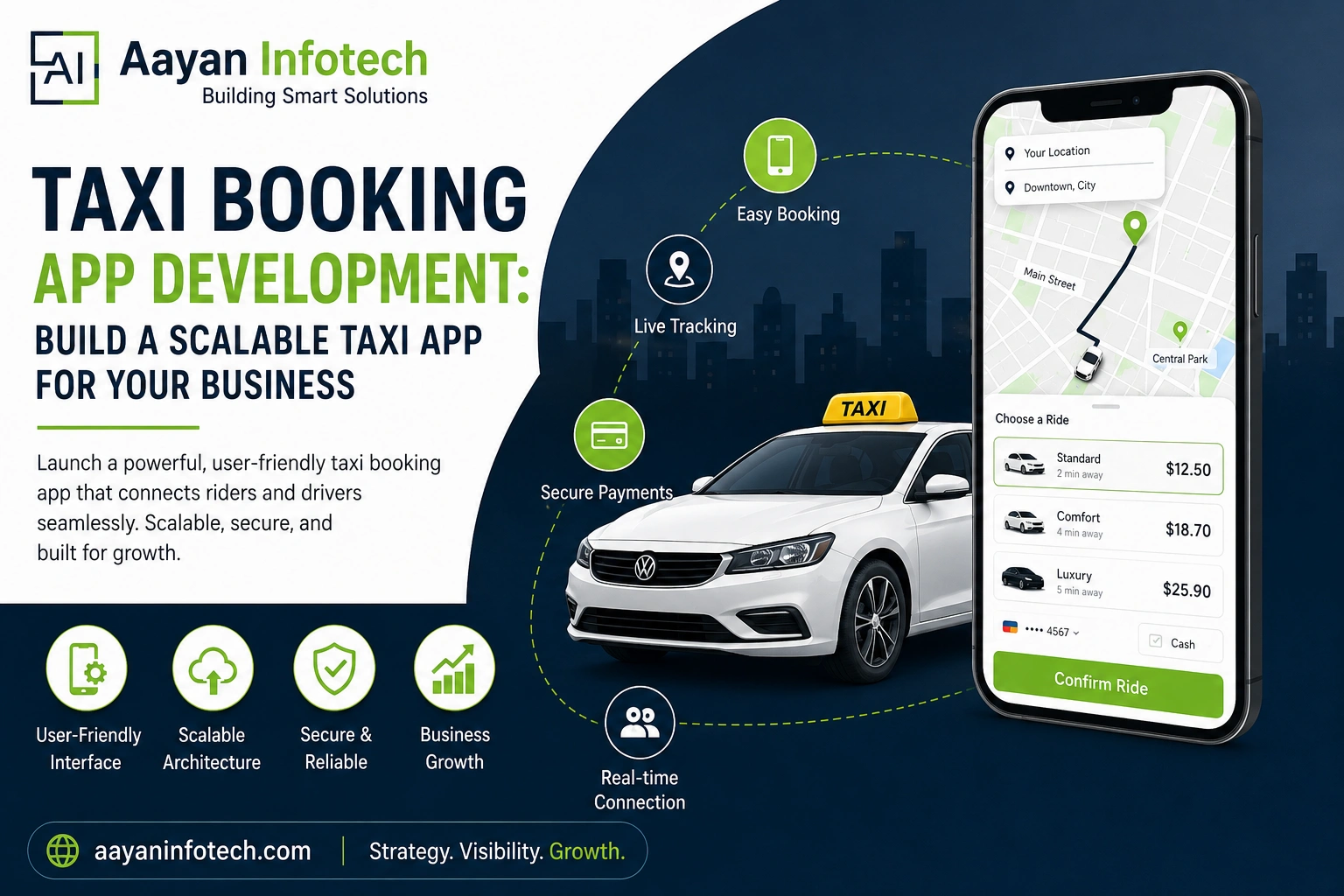
Taxi Booking App Development involves designing and building a digital platform that allows passengers to book rides through a mobile application while drivers receive, accept, and complete ride requests through a separate driver application.
A complete taxi ecosystem generally includes:
The passenger can enter a pickup and destination location, view estimated fares, select a vehicle type, request a ride, track the driver, complete payment, and provide a rating.
The driver application manages availability, ride requests, navigation, earnings, trip history, and customer information according to the permissions and business rules defined by the platform.
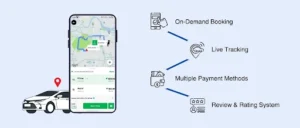
The traditional taxi business depends heavily on phone calls, dispatchers, and manual fleet coordination. A mobile platform can automate many of these activities while giving customers a more convenient booking experience.
A custom taxi app can help businesses:
Customers can book a ride from anywhere, receive driver information, track the vehicle, and complete payments through their smartphones.
Businesses can monitor driver availability, assign rides, manage driver profiles, and review performance through an administrative dashboard.
A taxi platform can generate revenue through commissions, booking fees, subscription plans, surge pricing, corporate accounts, advertising, or partnerships.
A scalable architecture allows businesses to launch in additional cities without rebuilding the entire application.
For example, a company may initially launch in Dubai, then expand into Abu Dhabi, Sharjah, Riyadh, London, or other international markets.
Successful Taxi Booking App Development requires more than a simple booking interface. The platform should connect passengers, drivers, administrators, maps, payments, and backend services.
The passenger application can include:
A simple and fast booking flow is particularly important because users may access the application while travelling or in unfamiliar locations.
The driver application can include:
The driver interface should be optimized for quick interactions so that drivers can manage trips without unnecessary navigation through multiple screens.
The admin panel provides centralized control over the taxi platform.
Important features include:
An administrator should also be able to configure different pricing rules for different cities, vehicle categories, service areas, and peak periods.
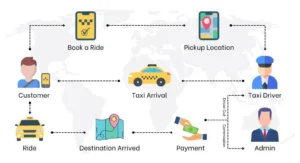
A typical taxi booking process follows a connected workflow that coordinates passengers, drivers, GPS services, payment systems, and the application backend. Each step plays an important role in delivering a smooth and reliable ride-booking experience.
The process begins when a passenger opens the taxi booking application and enters their pickup location and destination. GPS can automatically detect the passenger’s current location, while the destination can be selected by searching for an address or choosing a location on the map. The app then sends these details to the backend system, which prepares the ride information and begins calculating the available route and estimated travel details.
After receiving the pickup and destination details, the application uses mapping and routing services to calculate the estimated distance and travel time. Based on factors such as distance, ride type, base fare, duration, and applicable pricing rules, the system generates an estimated fare. This allows passengers to understand the expected trip cost before confirming the booking. Dynamic pricing can also be integrated to adjust fares during periods of high demand.
Once the passenger confirms the ride details, the backend identifies drivers who are available within a suitable area. The system considers factors such as driver location, availability, vehicle type, service area, and ride category. Real-time GPS data helps determine which drivers are closest to the passenger. This matching process helps reduce passenger waiting time while giving drivers relevant ride opportunities based on their location and availability.
The application sends the booking request to one or more eligible drivers through push notifications or in-app alerts. The driver can view important trip information, such as the pickup location, estimated distance, destination details, and potential fare. Depending on the business model, the request may be offered to the closest driver first or distributed among multiple drivers. The system tracks the response within a defined time period.
When a driver accepts the request, the booking status changes from pending to confirmed. The backend immediately updates the passenger application and prevents the same ride from being assigned to another driver. The driver receives the passenger’s pickup details and navigation options. At this stage, the system also records important booking information, such as driver identity, vehicle details, acceptance time, and ride status, helping maintain accurate records throughout the trip.
After the booking is confirmed, the passenger receives information about the assigned driver and vehicle. This may include the driver’s name, profile photo, vehicle model, vehicle color, registration number, rating, and estimated arrival time. Providing these details helps passengers identify their assigned vehicle and improves trust and safety. The passenger can also contact the driver through integrated calling or messaging features without exposing unnecessary personal contact information.
Real-time GPS tracking allows both passengers and drivers to monitor the ride location. Before pickup, passengers can see the driver’s movement and estimated arrival time on the map. Once the trip begins, the application continues tracking the vehicle’s route. The backend receives location updates and displays relevant information in the passenger and driver apps. This feature improves transparency and can also support trip monitoring, navigation, safety tools, and accurate distance-based fare calculations.
The driver navigates to the passenger’s pickup location, starts the trip through the application, and drives toward the destination. During the journey, the system can track trip status, route progress, location, and travel duration. Once the driver reaches the destination, the ride is marked as completed. The application then sends the final trip information to the backend, ensuring that the completed journey is properly recorded for payment processing, driver earnings, passenger history, and administrative reporting.
After the ride ends, the system calculates the final fare using actual trip information. The calculation may consider distance traveled, trip duration, base fare, waiting time, tolls, taxes, service fees, discounts, and surge pricing where applicable. The final amount can differ from the initial estimate if the actual route or trip duration changes. The passenger receives a clear fare breakdown so they can understand how the final ride amount was calculated.
The final stage involves payment and feedback. The passenger can pay using an integrated payment method such as a card, digital wallet, or other supported option. Once payment is successfully processed, the system generates the ride receipt and updates the driver’s earnings. The passenger can then rate the driver and provide feedback about the experience. Ratings and reviews help businesses monitor service quality, identify issues, and improve the overall taxi booking platform.
Location tracking is one of the most important components of Taxi Booking App Development. Passengers need accurate driver locations, while businesses need real-time visibility into active trips.
However, location access should be implemented carefully. Android documentation explains that applications using location services must request appropriate location permissions and distinguish between foreground and background access.
A taxi application can use location technology for:
The application should request only the permissions required for its actual functionality and clearly explain why location access is needed.
The technology stack depends on the project’s target markets, budget, performance requirements, and long-term expansion plans.
A typical technology architecture may include:
| Component | Possible Technologies |
| Mobile App | Flutter, React Native, Kotlin, Swift |
| Backend | Node.js, Python, Java, PHP |
| Database | PostgreSQL, MySQL, MongoDB |
| APIs | REST APIs, GraphQL |
| Maps | Google Maps Platform or other mapping APIs |
| Cloud | AWS, Google Cloud, Azure |
| Notifications | Firebase Cloud Messaging, APNs |
| Authentication | OAuth, OTP, secure authentication |
| Analytics | Custom dashboards and analytics platforms |
Aayan Infotech develops mobile applications using Flutter, React Native, and native technologies based on project requirements.
For startups, cross-platform development can help reduce duplicated development effort. For applications requiring highly platform-specific capabilities, native development may be more appropriate.

Security should be incorporated throughout the development lifecycle rather than added after launch.
A taxi platform may process names, phone numbers, location information, payment-related data, driver documents, and ride histories. These areas require strong security controls.
The OWASP Mobile Application Security Verification Standard (MASVS) provides security controls covering areas such as authentication, secure storage, cryptography, network communication, privacy, and platform interaction.
Important security measures can include:
Security requirements should also be reviewed according to the countries and regulations where the taxi service operates.
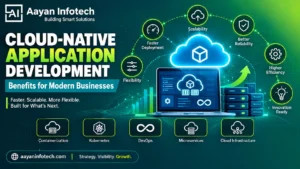
Scalability should be part of the architecture from the first development phase.
Separate the booking, payment, notification, user, driver, and reporting components so individual services can evolve without affecting the entire platform.
Well-structured APIs allow mobile applications, web dashboards, partner platforms, and future services to communicate with the backend.
Cloud infrastructure can provide resources that scale according to application demand.
Indexes, caching, query optimization, and appropriate database architecture can help maintain performance as ride records increase.
Taxi apps require real-time ride status and driver-location updates. Technologies such as WebSockets or other real-time communication mechanisms can support these requirements.
A scalable taxi platform should support multiple service areas, currencies, languages, time zones, vehicle types, and pricing rules when international expansion is planned.
A professional development process normally includes several stages.
The first step is understanding the target market, competitors, customer expectations, regulations, vehicle categories, and business model.
For example, a taxi platform targeting Dubai may have different operational requirements from one targeting New York, London, Mumbai, or Sydney.
Designers create passenger, driver, and admin interfaces. The focus should remain on simple navigation, quick booking, readable information, accessibility, and mobile usability.
An MVP can include essential booking, driver matching, GPS tracking, payment, notification, and administrative functions.
This allows businesses to validate their concept before investing in advanced functionality.
Developers build APIs, databases, authentication, booking logic, pricing systems, driver management, and administrative services.
The application can then integrate mapping, payment, notification, analytics, and communication services.
Testing should cover:
After app-store deployment, the platform requires monitoring, bug fixes, security updates, performance optimization, and feature improvements.
The cost of Taxi Booking App Development varies significantly because every taxi platform has different requirements.
Major cost factors include:
A basic MVP will generally require a smaller investment than a multi-city platform with advanced dispatching, corporate accounts, multiple payment systems, analytics, loyalty programs, and complex fleet management.
Instead of choosing a development budget only by feature count, businesses should evaluate the expected user volume, geographic expansion, operational complexity, and long-term maintenance requirements.
If the goal is to promote a taxi booking business in specific markets, the website should include relevant location-based content without keyword stuffing.
Potential location keywords include:
Location-specific landing pages should provide genuinely useful information about the market, service requirements, business opportunities, and development considerations.
For a software development company, LocalBusiness and Service schema, optimized service pages, Google Business Profile activity, location-relevant content, and authoritative industry backlinks can support local visibility.
Choosing the right development partner is important because a taxi platform involves multiple connected systems rather than a single mobile application.
Aayan Infotech provides end-to-end mobile app development covering design, development, testing, deployment, and maintenance. Its service offering includes cross-platform and native technologies for different business requirements.
For a taxi business, the development team can help transform a business concept into a structured digital platform with passenger functionality, driver operations, administration, backend services, integrations, and scalability considerations.
The right development approach also makes it easier to introduce future capabilities such as corporate rides, scheduled bookings, loyalty programs, subscription packages, electric vehicle fleets, ride sharing, and advanced analytics.
Taxi Booking App Development can help taxi companies, transportation startups, and fleet businesses create a convenient digital booking experience while improving operational efficiency. A successful platform requires more than passenger booking. It needs reliable driver management, GPS tracking, payments, notifications, secure APIs, an administrative dashboard, and scalable backend infrastructure.
Businesses planning to enter markets such as Dubai, Abu Dhabi, London, New York, Toronto, Sydney, or India should design their platform around local customer expectations and future expansion from the beginning.
If you are planning to build a taxi booking platform, Aayan Infotech can help you plan, design, develop, test, and scale a custom mobile application based on your business model. Contact Aayan Infotech to discuss your taxi app idea, required features, target market, technology stack, and development roadmap.