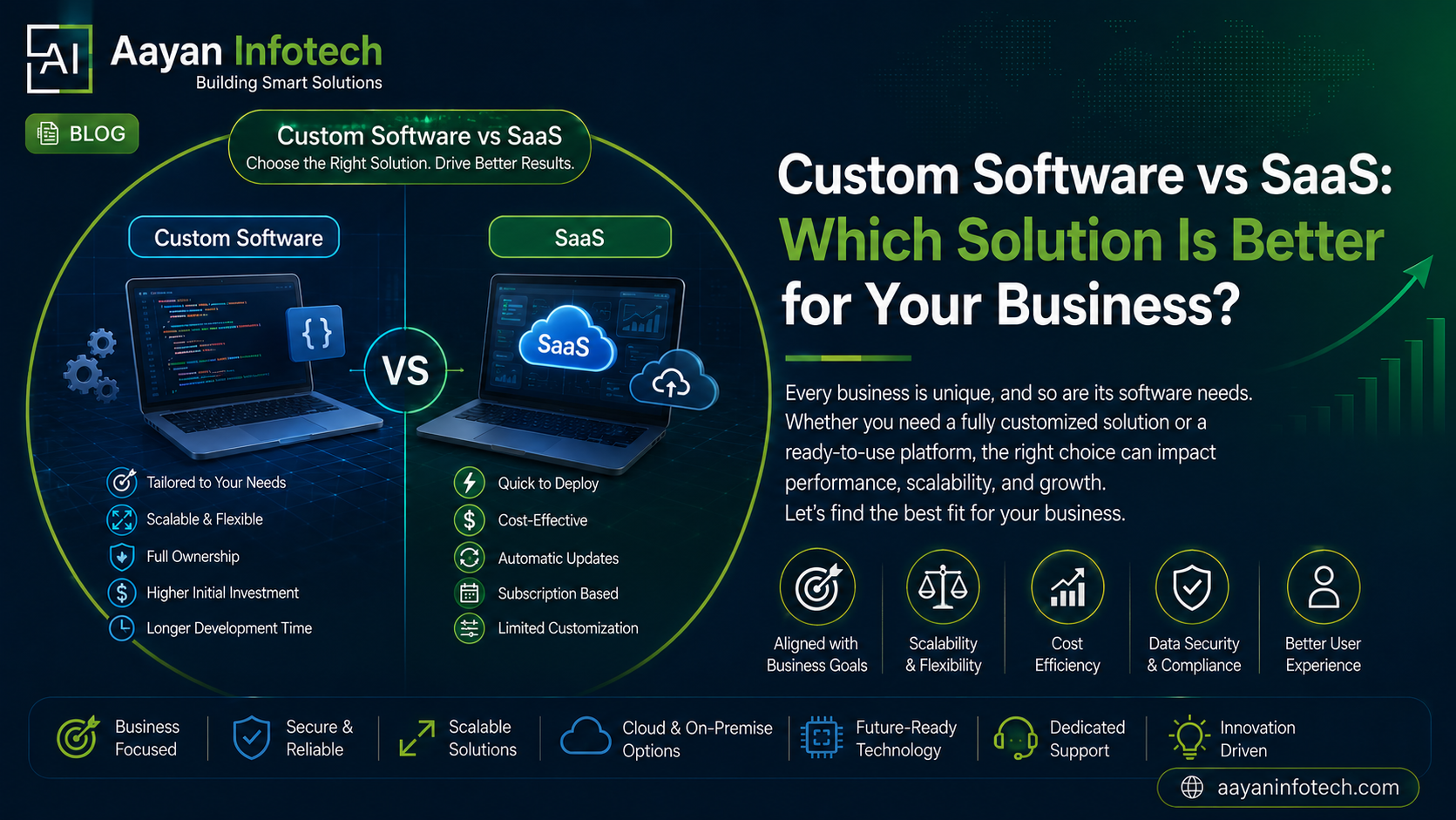
Choosing the right software can directly affect how efficiently a business operates, serves customers, manages data, and scales. When comparing Custom Software vs SaaS, businesses often face a difficult decision: should they invest in a solution built specifically for their processes, or choose an existing Software as a Service platform that is ready to use?
Both options can deliver value, but they solve different business problems. SaaS can provide faster deployment and predictable subscription costs, while custom software can offer greater control, flexibility, integration, and scalability. For startups, SMEs, and enterprises in India, the right choice depends on business requirements, budget, growth plans, security expectations, and the level of customization required.
Custom software is a technology solution designed and developed specifically for a particular business, industry, workflow, or customer requirement. Instead of adapting business processes to an existing application, custom software allows the application to be designed around the company’s actual needs.
Custom software development can include:
Aayan Infotech provides custom software development services designed around business requirements, including planning, development, testing, deployment, and ongoing support.
SaaS stands for Software as a Service. It is a cloud-based software delivery model where users access an application managed by a service provider instead of managing the underlying infrastructure themselves.
According to the National Institute of Standards and Technology (NIST), SaaS allows consumers to use provider-managed applications running on cloud infrastructure, commonly through a web browser or application interface.
Common SaaS examples include software for:
SaaS platforms are generally attractive because businesses can subscribe, configure the application, and begin using it without building the entire software system from scratch.
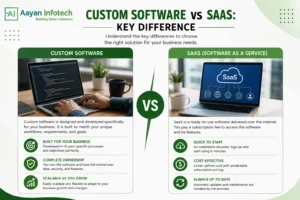
The biggest difference between Custom Software vs SaaS is ownership and flexibility. With custom software, the solution is designed around the organization’s requirements. The business has much greater control over features, workflows, integrations, user roles, data architecture, and future development.
With SaaS, the company uses an existing product developed for a wider customer base. The business can usually configure available features, but it must work within the platform’s capabilities and policies.
| Factor | Custom Software | SaaS |
| Development | Built specifically for the business | Already developed |
| Initial Cost | Usually higher | Usually lower |
| Deployment | Requires development and implementation | Usually faster |
| Customization | Very high | Limited to available features |
| Scalability | Designed around business growth | Depends on provider |
| Integrations | Can be built specifically | Depends on available integrations |
| Control | Greater control | Provider controls core platform |
| Maintenance | Business/development partner managed | SaaS provider managed |
| Pricing | Development investment + maintenance | Subscription-based |
| Long-Term Flexibility | High | Depends on vendor |
| Data Control | Greater architectural control | Depends on provider |
| Best For | Unique or complex requirements | Standard business needs |
Cost is one of the first factors businesses consider when evaluating Custom Software vs SaaS.
SaaS generally has a lower starting cost because the software has already been developed. Businesses usually pay monthly or annual subscription fees based on users, features, storage, or usage.
Custom software requires a larger initial investment because the solution needs discovery, UI/UX design, architecture, programming, testing, deployment, and support.
However, businesses should not compare only the initial price.
A SaaS platform may become expensive over several years because of recurring subscriptions, additional user charges, premium features, integration costs, and vendor-specific pricing.
Custom software can require more upfront investment but may provide greater long-term value when it supports critical workflows, reduces manual work, and eliminates the need to pay for unnecessary features.
The better question is not simply “Which is cheaper?” but “Which solution provides better business value over its expected lifetime?”
Customization is one of the strongest advantages of custom software.
A standard SaaS platform must serve many different businesses. As a result, its features are designed to address common requirements.
Custom software works differently.
Developers can design workflows around the company’s processes. Specific dashboards, approval systems, user roles, reports, automation rules, APIs, and integrations can be created according to business needs.
For example, an Indian logistics company may require a platform that connects:
If an existing SaaS product cannot support the complete workflow, custom development may provide a more practical solution.
Business growth can change software requirements.
A startup may initially need a simple CRM, while an expanding company may later require advanced reporting, automation, multiple user roles, ERP integration, AI features, or customer-facing applications.
SaaS platforms can scale within the limits of the provider’s architecture and pricing plans.
Custom software can be architected specifically for expected business growth. Developers can plan the technology stack, database architecture, APIs, cloud infrastructure, and security model according to future requirements.
Aayan Infotech states that its custom software solutions focus on scalability, performance, security, and long-term business requirements.
Modern businesses rarely operate with a single technology platform.
A company may need connections between:
SaaS platforms often provide pre-built integrations. This can be convenient when the business uses popular systems.
However, complex integration requirements can become difficult when the SaaS provider does not support a specific API, data flow, or workflow.
Custom software can be developed with integration requirements included in the original architecture.
Aayan Infotech also provides API development and software integration services for connecting different systems and supporting interoperability.
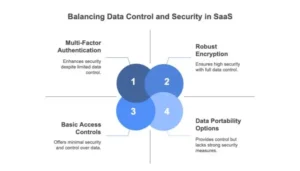
Security should be evaluated carefully before choosing either approach.
SaaS providers typically manage infrastructure, application updates, security controls, and maintenance. This reduces the technical workload for the customer but also means the business depends on the provider’s security practices and policies.
NIST identifies SaaS as a cloud service model in which consumers do not manage or control the underlying cloud infrastructure.
Custom software can provide greater control over architecture, access permissions, integrations, hosting strategy, and data workflows.
However, custom software does not automatically mean better security. Security depends on development practices, infrastructure, authentication, encryption, monitoring, testing, backups, and ongoing maintenance.
Businesses handling financial, healthcare, personal, or other sensitive information should evaluate security requirements before selecting a solution.
SaaS has a major advantage when speed matters.
A business can often subscribe to a SaaS platform, configure users, import data, and start operating relatively quickly.
Custom software takes longer because it requires discovery, planning, design, development, quality assurance, deployment, and training.
Aayan Infotech describes a development process covering planning and analysis, design and development, testing and quality assurance, deployment, and support.
Therefore, SaaS may be more appropriate when a business needs an immediate standard solution.
Custom development may be better when the organization is willing to invest time in building a solution that closely matches its long-term requirements.
SaaS may be the better option when:
For many small businesses and startups in India, SaaS can be an efficient starting point.
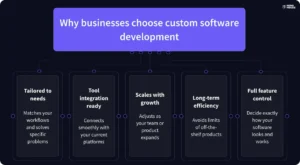
Custom software may be a better fit when:
For example, an Indian manufacturing company with specialized production, inventory, quality-control, and supplier workflows may benefit from a custom platform instead of forcing its processes into a generic application.
Startups often face a difficult balance between speed and scalability. SaaS can help a startup launch quickly without a large software development investment. It can be useful for standard functions such as accounting, project management, communication, and basic CRM.
However, custom development can become valuable when technology itself is the startup’s product or competitive advantage. A startup building a marketplace, fintech platform, healthcare system, logistics network, AI product, or specialized B2B platform may need technology that cannot be adequately delivered through multiple off-the-shelf tools.
The decision should therefore be based on whether the software is simply supporting the business or is becoming part of the business’s core product.
Large organizations often have more complex requirements. Enterprise businesses may have multiple departments, locations, teams, databases, legacy applications, compliance requirements, and third-party systems.
In such cases, custom software can help create a unified technology environment. However, enterprises do not necessarily need to replace every SaaS application. A hybrid approach can be more effective.
For example:
Custom software: Core business operations and proprietary workflows
SaaS: Standard accounting, collaboration, email, or productivity functions
Cloud services: Infrastructure and scalable computing
APIs: Connections between systems
This approach can combine the flexibility of custom development with the convenience of SaaS.
Businesses do not always have to choose only one option.
A hybrid technology strategy can use SaaS for standard business functions while custom software handles unique processes.
For example, a company could use a SaaS accounting platform while developing custom software for inventory management and connecting both systems through APIs.
This approach can reduce development costs while preserving flexibility where it matters most.
Before making a decision, evaluate these questions:
List the workflows that the software must support. Separate essential requirements from optional features.
If your processes are similar to those of many businesses, SaaS may be sufficient. If they are highly specialized, custom development may provide more value.
Think beyond the current number of users. Consider future locations, departments, customers, transactions, integrations, and features.
Determine where data should be hosted, who needs access, how it should be protected, and what regulatory or contractual requirements apply.
Compare development or subscription costs, maintenance, upgrades, integrations, training, support, migration, and future expansion.
If software functionality can differentiate your company from competitors, investing in custom technology may be strategically valuable.
Aayan Infotech provides custom software development services for businesses seeking technology aligned with specific operational and growth requirements.
The company states that it works with startups, enterprises, and global brands and provides development services covering requirements analysis, design, development, testing, deployment, and maintenance.
Aayan Infotech also lists capabilities across technologies such as React, Angular, Node.js, Python, Java, .NET, AWS, Azure, Flutter, React Native, and modern AI frameworks.
For businesses in India, Aayan Infotech has an India office in Lucknow, Uttar Pradesh, and provides custom software, AI, web, mobile, cloud, and enterprise technology services.
Whether you need an enterprise application, business automation platform, customer portal, SaaS product, mobile application, or API-driven system, the development approach should begin with your business requirements rather than a predefined technology stack.
The decision between Custom Software vs SaaS should be based on your business strategy rather than simply the initial software cost. Choose SaaS when you need a ready-to-use solution for standard business requirements, faster deployment, and predictable subscription-based access.
Choose custom software when your workflows are unique, your software is strategically important, or you require greater flexibility, integration, scalability, and control. For many growing businesses, the best solution can be a combination of both.
If you are evaluating Custom Software vs SaaS for your business in India, Aayan Infotech can help assess your requirements, technology architecture, integrations, scalability needs, and long-term objectives before development begins. Ready to choose the right software approach? Contact Aayan Infotech to discuss your business requirements and explore a custom technology solution designed around your goals.