
Modern mobile applications may look simple on the surface, but behind every smooth swipe, instant response, secure login, or real-time update lies a powerful engine — the mobile app backend. To engage in intensive, scalable and secure digital experience, backend architecture nowadays is fundamental to the business needs of companies intending to do so. At Aayan Infotech, we specialise in mobile app backend development and custom mobile app development that turn ideas into intelligent, result-driven digital solutions.
This tutorial divides the gaining success of a mobile application into its backend and the technologies that run it under the hood.
A mobile app is the iceberg, one can only see the tip of the interface on the surface and then the majority of the work is underwater. The mobile app backend manages everything users do not see: data processing, authentication, data storage, security, push notifications, integrations, and real-time updates.
Back end systems be it a fitness application with data connected to the cloud, e-commerce application where payments are being processed, or an enterprise application storing customer data, accuracy, speed and reliability is guaranteed. Even the sadly designed mobile application will not be smooth without the right backup.
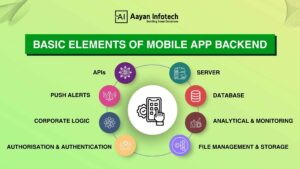
A server acts as the working point within which application logic is executed. It takes in requests made by clients, does calculations, uses API calls and makes communication between the frontend and the database. A scalable server infrastructure means that it will be scaled, available and perform continuously.
These can be cloud-based (AWS, Azure, Google Cloud), on-premise systems that are physical or hybrid.
A mobile app is only as strong as its database. Databases store and organise crucial information such as user details, content, transactions, preferences, and app-generated data.
Mobile app backend development commonly uses:
A well-designed database schema ensures quick data retrieval, minimal downtime, and high-speed operations.
The APIs are utilized as the communication interface between the front and back end of the app. Bringing products information, editing user profile, or payment — all these are enabled by APIs.
Common API architectures are designed to allow a smooth communication process, and they are REST, GraphQL, and gRPC.
Security is non-negotiable in mobile app development. Authentication verifies user identity, while authorisation determines what each user can access.
Popular authentication systems include:
A secure backend protects sensitive data, ensures compliance, and builds user trust.
Corporate logic or business logic is a set of rules that determines the behavior of an application based on business rules. It carries out fundamental functions that include pricing calculations and recommendations, payment policies, workflow automation, and processes.
This layer provides a guarantee that users can always have the same and correct results on all actions they do.
Files such as images, videos, documents, and user uploads require secure and efficient storage.
Backend solutions often use:
Proper file management helps maintain performance and reduce load times.
The use of push notifications ensures that the users are continuously entertained by providing real-time information, reminders, and messages with promotions. These alerts are activated and controlled by the backend depending on the behaviour of the user, preferences and logic of the app.
Firebase Cloud Messaging (FCM), Apple Push Notification Service (APNs), and third-party automation are some of the technologies.
Backend analytics are used to monitor user behaviour, crashes, performance problems and usage trends. Monitoring tools are needed to make sure that the system is stable, secure and optimised.
Real-time analytics increases user interactions and allows the enhancement of data-driven improvement.
SaaS services come in the form of a pre-built backend which might be CRM, ERP, authentication or analytics module.
They are short-time and cost-effective solutions, which are suitable in startups and other small enterprises wishing to deploy solutions within a short period. They can, however, have low levels of customisation.
MBaaS has already developed back-end building blocks such as databases, APIs, authentication, and push notifications. Firebase, Backendless and AWS Amplify are among the popular ones.
MBaaS is high-level easy to develop, less code is needed and in-built scalability to the cloud – ideal in MVPs or high growth applications.
For businesses with unique requirements, custom mobile app development offers complete flexibility. Aayan Infotech will develop model system specific backend that fits your needs: workflow, security, and scalability considerations.
Custom backend development is preferred for:
A tailor-made solution ensures long-term performance, security, and total control over your architecture.
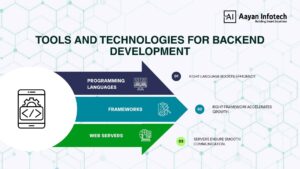
Backend developers use a range of languages depending on project needs:
Each language offers unique performance benefits, security features, and scalability options.
Frameworks accelerate development with ready-to-use templates, libraries, and structures:
Choosing the right framework depends on app complexity, speed requirements, and integration needs.
Web servers manage requests, deliver responses, and handle application logic:
A high-performing web server ensures reliability and fast response times.
The mobile app backend truly is the “engine under the hood” — a powerful system that drives seamless performance, security, and user satisfaction. Servers, databases, APIs, and push notifications, as well as analytics, are all important to ensure that an app is operating smoothly.
At Aayan Infotech, our expertise in mobile app backend development and custom mobile app development helps companies build robust, scalable, and future-ready applications. Your mobile application can perform well in the digital era because of the right backend strategy, which can deliver the expected performance and reliability. Contact us today at +91 7007120194 or email us at info@aayaninfotech.com.